

Unit 9 The conflict game
When should people be competitive and when should they cooperate with each other to get a better result? This experiment addresses questions of cooperative and competitive behaviour. It also helps students understand basic concepts of game theory, including a Nash equilibrium, and how incentives affect individuals’ bargaining decisions.
CORE projects
Concepts in the experiment are related to the material in:
9.1 Introduction
In a two-person negotiation, should people be competitive or try to cooperate with each other to get a better result? How do negotiators’ incentives affect the ease with which an agreement can be reached? When conflict between the interests of both parties increases, are people more likely to negotiate aggressively or peacefully? Conflict and bargaining are closely related in various everyday situations. Political parties clash for government control, unions go on strike, legal disputes end up in court, and firms compete in aggressive price wars. Not all negotiations have the same level of conflict. Some situations are simple, such as couples’ arguments over the distribution of tasks, and others are much more complex, such as clashes between nations to define trade agreement conditions.
For simplicity, we can say there are two ways of approaching a negotiation: being a Hawk or a Dove. In this metaphor, negotiating as a Hawk is to approach conflict aggressively and selfishly, putting personal interests above those of the group. In contrast, acting as a Dove implies seeking the common good and preferring cooperative relationships. Arguably, we do not behave the same way all the time, in all situations. Therefore, analysing the conditions that favour selfish behaviour and under what conditions cooperation flourishes is exciting. The discussion about the conflict between cooperation and self-interest is covered in Section 4.10 of The Economy 2.0: Microeconomics (Section 4.9 of The Economy 1.0).
This game addresses questions of cooperative and competitive behaviour, and facilitates the explanation of Nash equilibrium and other basic game theory concepts. The learning objective is to understand how incentives affect individuals’ bargaining decisions.
The experimental protocol uses a stylized model that captures different levels of preference alignment. It is inspired by the 2×2 conflict game originally proposed by Baliga and Sjöström (2004), discussed extensively in Palacio, Cortés, and Muñoz (2015).
How to cite this unit
Palacio García, Luis Alejandro and Daniel Parra. 2023. ‘The conflict game’. Unit 9 in The CORE Team, Experiencing Economics. Available at https://www.core-econ.org/experiencing-economics/experiments/09-the-conflict-game.html [Accessed on (date)].
Key concepts
This experiment will help students understand the following key concepts:
- Nash equilibrium
- Efficiency
- Coordination
- Cooperation
- Negotiation.
9.2 Requirements
Timing
The game is quick to run as it only consists of one decision made by each participant in each of the five rounds. Explaining the game and running five rounds takes about 20 minutes. Remember to allow time for a stimulating discussion.
9.3 Description of the experiment
There are two types of players, Blue and Green, who make their decisions simultaneously, choosing between two alternatives, Dove or Hawk. The payoffs may be interpreted as the outcomes of a couple negotiating how to split a prize worth 2000. Each one can negotiate as a Dove or as a Hawk. Therefore, there are three possible outcomes:
- If both negotiate like a Dove, they do not confront each other and they split the prize equally.
- If both negotiate like a Hawk, they will fight fiercely, hurting each other, and getting only 250 each.
- If one negotiates like a Hawk and the other like a Dove, the Hawk gets a prize of \(Y\), while the Dove gets \(X\).
9.4 Step-by-step guide
Detailed instructions
Go to the ‘Quick summary’ section if you have previously run the experiment and just need a brief reminder of the instructions.
9.5 Student instructions
These instructions are also available in the students’ version.
A PDF of the student instructions and homework questions is also available.
Introduction
In this game, you will play five rounds. In each round, you will be randomly matched with another student. Both of you will have to decide simultaneously how to behave in negotiating a deal worth 2000: cooperatively (as a Dove) or aggressively (as a Hawk). At the end of the round, you will receive a payoff according to the information in the payoff matrix (see Figure A for an example).
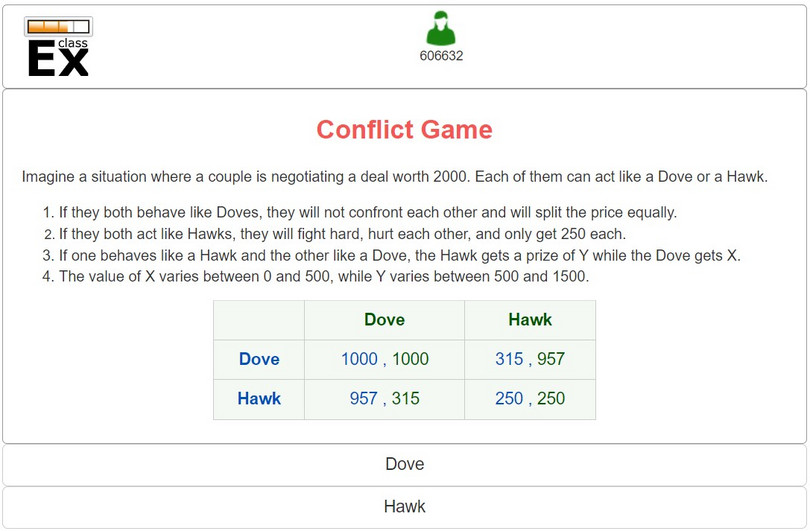
Figure A Students’ screen for a realization of \(X=315\) and \(Y=957\).
Observe that in each round, you might play with a different student who will be randomly selected from all participants. Sometimes you will be the Blue player, and at other times the Green player. Finally, recall that you will both decide simultaneously and play five rounds.
Profits
Profits are calculated using the two variables, \(X\) and \(Y\). The value of \(X\) will always be a random number between 0 and 500, and that of \(Y\) will be a random number between 500 and 1500. They will take a different value at the beginning of each round. Participants will know the round’s value before they decide.
Note that there are three possible payoff combinations. At the end of the experiment, you will earn the sum of the profits of all the rounds.
- If both students in the pair behave as a Dove, they will not fight and will therefore split the 2000 prize equally.
- If both behave as a Hawk, they will fight fiercely, hurting each other and getting only 250 each.
- If one behaves as a Hawk and the other as a Dove, then the Hawk gets a prize of \(Y\), while the Dove gets \(X\).
Figure B shows this explanation and other details that will be shown on your instructor’s screen.
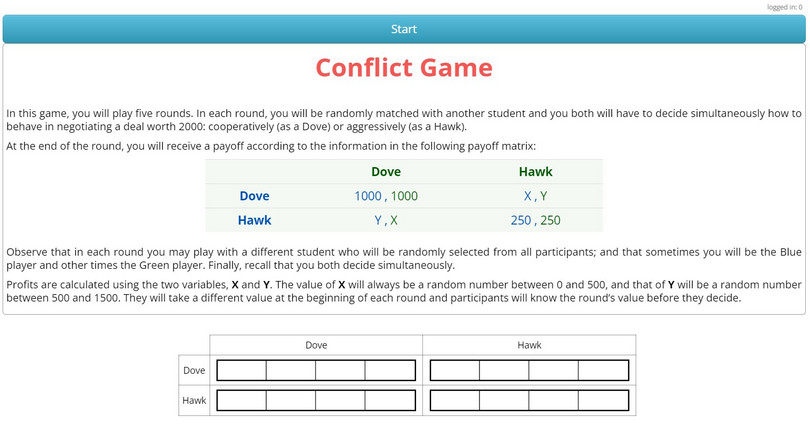
Figure B Instructor screen.
9.6 Predictions
Predicted results
The game has four different scenarios that depend on the \(X\) and \(Y\) values. In other words, this meta-game contains four different games (scenarios): C1. Dominant Dove: \(Y<1000\) and \(X>250\); C2. Strategic complements (stag hunt): \(Y<1000\) and \(X<250\); C3. Strategic substitutes (chicken): \(Y>1000\) and \(X>250\); and C4. Dominant Hawk (prisoners’ dilemma): \(Y>1000\) and \(X<250\).
9.7 Discussion
A good discussion following the experiment is essential. Ask your students the following questions to frame the discussion.
9.8 Homework questions
These questions can be set for students to work on outside the classroom or can be completed and discussed in the classroom. They may help students reflect on their experience and understand their own and others’ behaviour in the experiment.
Data from your experiment can be downloaded as an Excel file from the ‘data’ menu on the instructor’s screen in classEx. You can use this data to create your own questions. A description of the data variables can be found in the ‘Downloading the data from your experiment’ section.
This experiment complements the lectures and workshop exercises of a first game theory class. Those studying Unit 4 in The Economy 2.0: Microeconomics (Unit 4 in The Economy 1.0) will find this game particularly helpful. Specifically, it is a design that allows modelling different levels of conflict, where classic dilemmas such as the stag hunt, the chicken, and the prisoners’ dilemma are considered as particular cases. The following is an exercise to be carried out in the form of a theoretical problem set to reinforce the concepts related to game theory.
The following text is also available in the students’ version.
The conflict game
There are two players: Blue and Green. Blue will choose between Dove and Hawk and Green between Dove and Hawk. Both will make their decision simultaneously. The payoffs are represented in Figure C. In addition, there are two variables, \(X\) and \(Y\). The value of \(X\) will always be a number between 0 and 500, and the value of \(Y\) will always be a number between 500 and 1500.
| Dove | Hawk | |
|---|---|---|
| Dove | 1000 , 1000 | X , Y |
| Hawk | Y , X | 250 , 250 |
Figure C Payoff matrix.
- Represent the following four games in normal form and then find the Nash equilibria:
- \(Y\) < 1000 and \(X\) > 250
- \(Y\) < 1000 and \(X\) < 250
- \(Y\) > 1000 and \(X\) > 250
- \(Y\) > 1000 and \(X\) < 250.
- Represent the above four games in their extensive (sequential) form with perfect information and find the perfect Nash equilibrium in subgames.
- Clearly define a way to measure conflict in this game by a quantitative variable. Explain your answer.
9.9 Further reading
Also available in the students’ version.
- ‘The Disturbing New Relevance of Theories of Nuclear Deterrence’ (The Economist, 18 March 2022) describes how Schelling’s game-theoretic analysis helps to understand the conflict in Ukraine and the nuclear brinkmanship between Russia and the West.
- ‘What the Protracted Game of Chicken Over First Republic Tells Us’ (Financial Times, 1 May 2023) uses the game of chicken to explain the protracted stand-off between the two banks, where each side hopes the other will blink first and give up or compromise.
- Schelling, Thomas C. 1956. ‘An Essay on Bargaining’. The American Economic Review 46 (3): pp. 281-306 presents a theory of conflict and cooperation.
- Baliga, Sandeep and Sjöström, Tomas. 2012. ‘The Strategy of Manipulating Conflict’. American Economic Review 102 (6): pp. 2897-2922 presents the original 2×2 conflict game.
- Palacio, Luis A., Cortés-Aguilar, Alexandra, and Muñoz-Herrera, Manuel. 2015. ‘The Strategic Role of Nonbinding Communication’. Journal of Applied Mathematics 910614 extensively discusses the conflict game, where the discussion of the Nash equilibrium concept is addressed in different bargaining contexts.
9.10 Instructor experience
In this section, we hear from instructors about their experience running the experiment with their students.
