

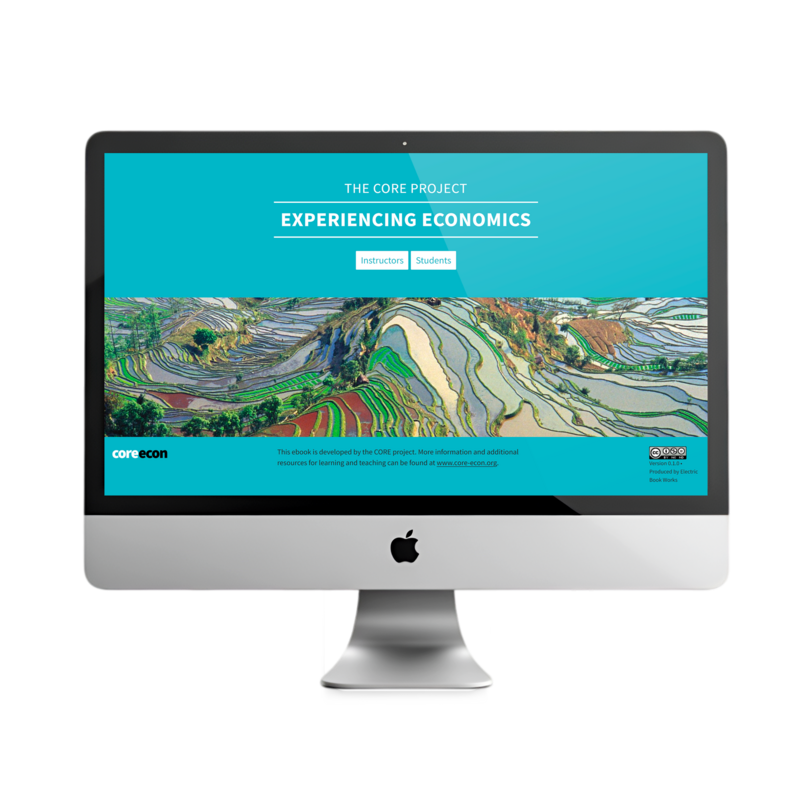
See features across all formats
Step-by-step instructions
Follow structured steps through experiments, data analysis, and economic reasoning.
Ready-to-run experiments
Bring economic concepts to life with classroom-ready activities.
Actual instructor and student screenshots
See how activities look in practice on the ClassEx platform, from student and instructor perspectives.
Discussion topics and questions
Spark conversation with prompts designed for classroom discussion.
Bookmarks and notes
Save your place with bookmarks and make notes with a free CORE account.
Full table of contents

Experiment 1Getting started with simple experiments
How can we make economic principles truly resonate with our students? This introductory chapter helps you incorporate experiments in your teaching and get familiar with the classEx platform. It provides three simple 2x2 games to get started.

Experiment 2The apple market: A simple experiment in buying and selling
How do competitive markets work? Who trades and how are the gains from trade distributed between buyers and sellers? Students go to the Farmers’ Apple Market to buy and sell bushels of apples in a competitive setting. This experiment is the first encounter with a market experiment, where students act as buyers and sellers.

Experiment 3Coordination game: Investment
What strategic considerations drive investment behaviour and coordination? Students, grouped in pairs, must choose simultaneously whether to invest or not under different frameworks. A simple coordination game reveals the relevance of the framing context.

Experiment 4Public goods game
Are humans able to cooperate to achieve socially beneficial outcomes, or do they succumb to free-rider incentives? A classic public goods game where students must decide how much to contribute to a common pool. The game can be played with and without the possibility to punish free riders.

Experiment 5The multiplier process
How does an individual’s choice of consumption affect the consumption, employment, production, and income of others? In this experiment, students experience the interdependence of demand choices and understand the multiplier process, the aggregate demand, and the business cycle.

Coming soonPhillips’ curve
Coming soon

Experiment 7An excise tax in the apple market
Who bears the burden of a tax? Students are back in the Farmers’ Apple Market, but now the local authority has decided to collect a tax for each bushel of apples sold. Students learn about tax incidence, deadweight loss, and taxation fairness.

Experiment 8Pollution, taxes, and permits
What policies are effective in mitigating negative externalities like pollution? Students participate in the market for coal, whose production generates pollution. The experiment provides insights into the functioning of Pigouvian taxes and pollution permits.

Experiment 9The conflict game
When should people be competitive and when should they cooperate with each other to get a better result? This experiment addresses questions of cooperative and competitive behaviour. It also helps students understand basic concepts of game theory, including a Nash equilibrium, and how incentives affect individuals’ bargaining decisions.

Experiment 10Network economies of scale: The Holophone
Why did some social networks succeed and become giants, while others offering similar services failed to take off? Students must decide whether to buy a new product whose buyer value increases with the number of units sold. The experiment offers a simple setting to discuss equilibrium dynamics, stability, and tipping points.

Experiment 11Competing standards
How did Facebook come to dominate the market for social networks? This experiment features a fierce battle for market supremacy between firms that offer products that are substitutes, in an environment where a product can quickly become popular and oust the competition.
Formats
Compare features across formats
Behind the book
Conducting economic experiments online and in the classroom is an effective way of getting students to use economics to think critically about the world around them and how it is represented in economic theory. Taking part in experiments motivates students by placing them in decision-making situations that correspond to the theoretical frameworks they are learning about. Watch co-author Humberto Llavador use the ebook with his students at Universitat Pompeu Fabra.

There is a profound shift when students move from listening to lectures to experiencing the economic forces firsthand. Experiments are a remarkably effective way to get students to use economics to think about the world around them, boosting performance and curiosity, and creating a spark of enthusiasm that we, as instructors, find truly contagious.
Humberto Llavador
Universitat Pompeu Fabra, Barcelona School of Economics

With a classroom experiment, students can experience economic interactions and models. They become part of the model and experience, e.g. the tractive power of an equilibrium. They are emotionally activated as they experience fair and unfair, as well as rational and less rational behaviour. When being connected to the lecture content afterwards, it helps to create an immersive experience-based approach to learning.
Marcus Giamattei
Frankfurt School of Finance and Management, University of Passau

Experiencing Economics is aptly titled. It is hard to imagine that a chemist can put herself in the place of a hydrogen molecule. A biologist who studies animal behavior is not likely to know how it feels to be a duck. Economics students are lucky. They can be actors as well as observers of economic drama. Economics has developed powerful theoretical tools for analyzing human interaction. Students can learn about these concepts just by reading. But if they get to play a role in an economic experiment and then analyze the results, the strengths and weaknesses of the corresponding theory will become more real to them, and these concepts are likely to find a place in their lifetime mental toolkit.
Ted Bergstrom
University of California, Santa Barbara
