
Experiment 2 The apple market: A simple experiment in buying and selling
How do competitive markets work? Who trades and how are the gains from trade distributed between buyers and sellers? Students go to the Farmers’ Apple Market to buy and sell bushels of apples in a competitive setting. This experiment is the first encounter with a market experiment, where students act as buyers and sellers.
CORE projects
Concepts in the experiment are related to the material in:
2.5 Student instructions
Introduction
It is a sunny Saturday morning at the Farmers’ Apple Market. You and your classmates have come to the market to buy and sell bushels of apples. Demanders value apples according to their buyer value. Suppliers must pay their seller cost if they want to sell a bushel of apples.
In any single round of trading, buyers cannot buy and sellers cannot sell more than one bushel of apples, nor can anyone buy or sell fractions of a bushel of apples.
Your role and the distribution of buyer values and seller costs are the same in each round, but they may change from one scenario to another, as different scenarios represent different markets.
Instructions
In this experiment, you will try to make profits by buying or selling (imaginary) bushels of apples. In each market scenario, you will be assigned a role, either as a Supplier who can sell one bushel of apples or as a Demander who can buy one bushel of apples (Figure A).
Your objective is to make as much profit as possible. Profit will be measured in ‘currency units’, which we will denote with a currency sign (we will use € in these instructions).
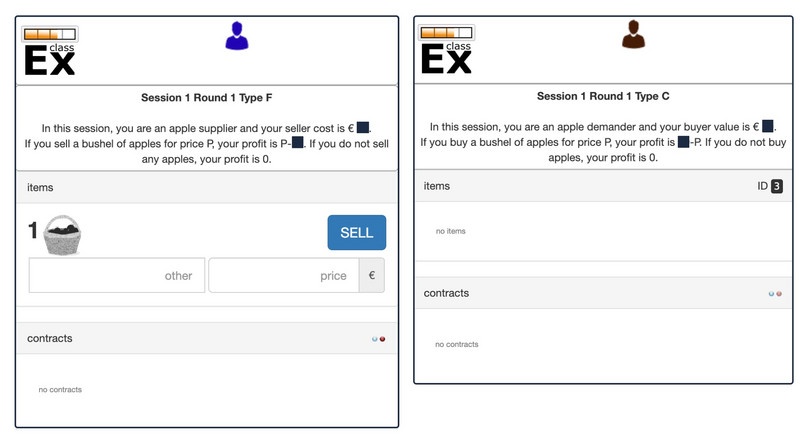
Figure A Screenshots of a Supplier (left) and a Demander (right) for offline trading. The Supplier screen displays their seller cost. The Demander screen displays their buyer value and ID number. Screens are similar for online trading, except that Demanders’ screens also display a ‘Buy’ button and price box to submit a buy offer, and there is no ID number.
If you are a Supplier, you will be assigned a seller cost (the cost of growing a bushel of apples), and you can sell at most one bushel of apples per round. If you sell a bushel of apples for a price \(P\), and your seller cost is \(SC\), then your profit from the transaction is the difference, \(P-SC\). If \(P \lt SC\), you are better off not selling and taking zero profit rather than selling for a loss.
If you are a Demander, you will be assigned a buyer value (your willingness to pay for a bushel of apples). You can buy at most one bushel of apples per round. If your buyer value is \(BV\), and you buy one bushel of apples for a price \(P\), your profit from the transaction will be \(BV-P\). This is the difference between how much you value the bushel of apples and how much you paid for it. If you have to pay more than your buyer value, you are better off not buying any apples and taking zero profit rather than buying a bushel for a loss.
At the beginning of the experiment, your instructor will announce whether you are using online or offline trading. Read the corresponding instructions for how to trade.
Offline trading
In offline trading, sellers and buyers must find each other and agree on a price. If they reach an agreement, the seller should type the price and the buyer’s ID on their screen and select the ‘Sell’ button. The buyer must accept the offer on their screen to finalize the contract (Figure B).
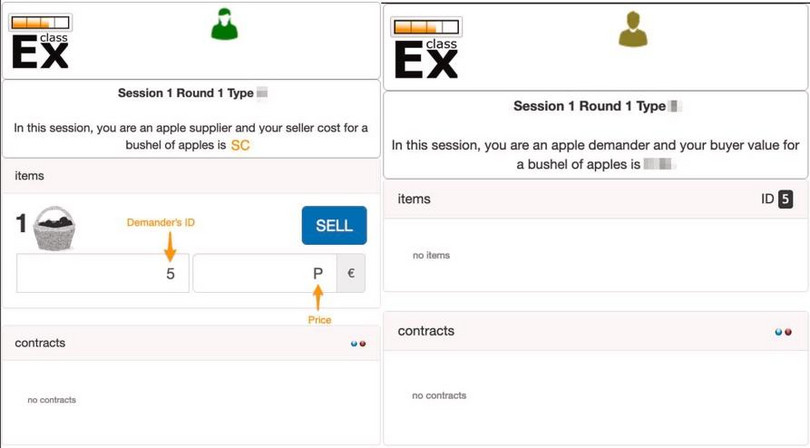
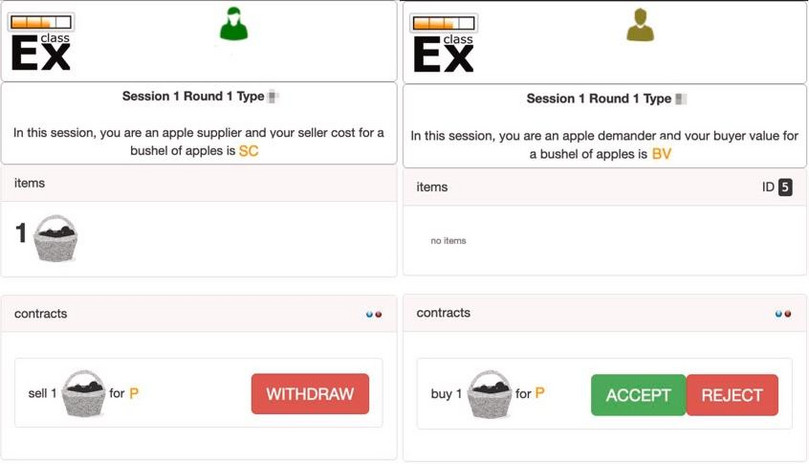
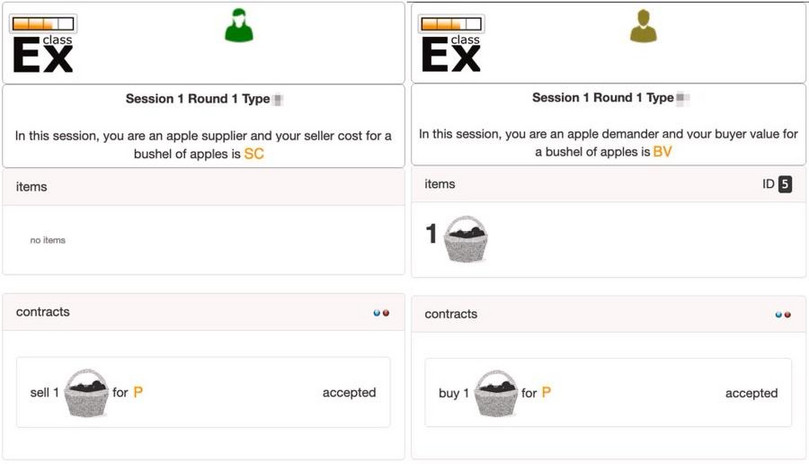
Figure B Offline trading: Once a buyer and a seller have reached a verbal agreement, they can formalize the transaction on their devices.
The sales contract is then publicly displayed on the instructor’s screen (Figure C).
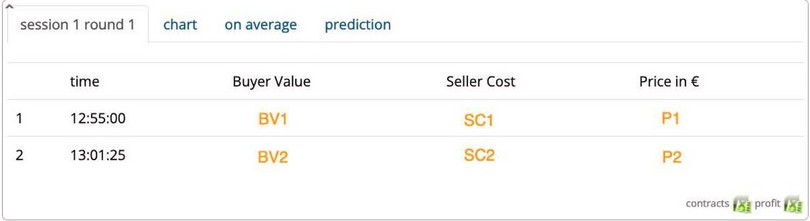
Figure C Each completed transaction is displayed in the instructor’s screen, showing the buyer value (\(BV\)), the seller cost (\(SC\)), and the price (\(P\)).
It is a good idea to think in advance about what you will do the first time you are in the market negotiating with other students. There are many strategies you could use, and there is not a single right answer. But remember to shop around and look at the prices that have already been posted on the instructor’s screen.
Online trading
In the online market, sellers can send a selling price that Demanders will see in the contracts section of their screens (Figure D). Similarly, buyers can send a buying price that Suppliers will see in the contracts section of their screens. Whether you are a Supplier or a Demander, your offer (if you made one) and all standing offers you can accept are shown in the contracts section of your screen. You can withdraw your offer and make a new one only if it has not been accepted yet. You can accept an offer by selecting the ‘Accept’ button. Note that once you accept an offer or your offer gets accepted, all other offers are automatically rejected, as you can only trade one bushel of apples.
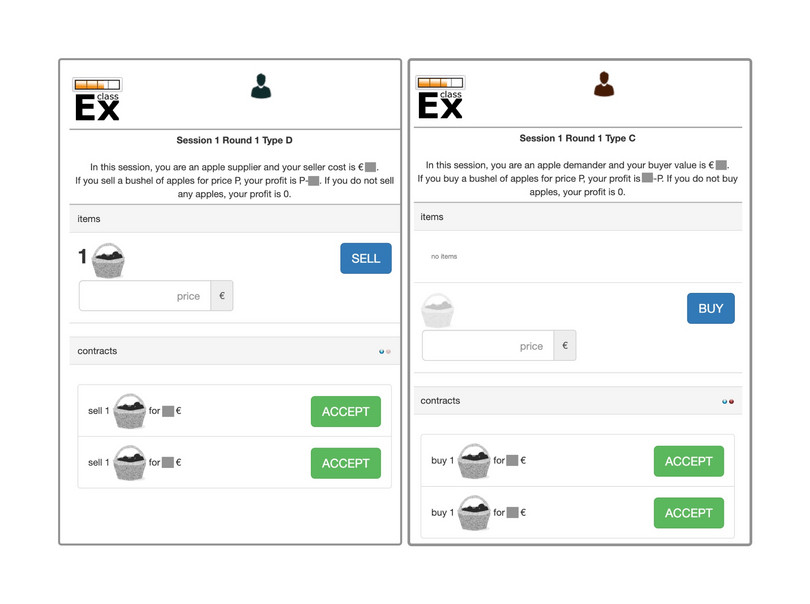
Figure D Screenshots of a Supplier (left) and a Demander (right) for online trading. The Supplier screen displays their seller cost and the buy offers received. The Demander screen displays their buyer value and the sell offers received.
When a buyer accepts a selling offer or a seller accepts a buying offer, the transaction takes place and is displayed on the instructor’s screen. The instructor’s screen also displays the standing buying and selling offers (Figure E). Look at it frequently for a general picture of standing offers and to get an idea of the price at which apples are being traded.
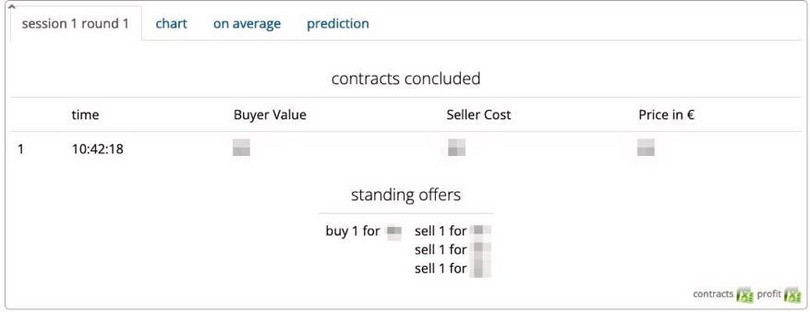
Figure E Instructor’s screen showing one completed transaction and standing buying and selling offers.
Warm-up questions
After reading the instructions for this experiment, please check your understanding by answering the following questions and recording what you expect to happen.
Suppose that a Supplier with a seller cost of €20 meets a Demander who has a buyer value of €40.
- If this Supplier sells a bushel of apples to this Demander for a price of €35:
- How much profit will the Supplier make?
- How much profit will the Demander make?
- How much is the total profit obtained by both traders? (Find this by adding the buyer’s profits to the seller’s profits.)
- Consider a higher price:
- What is the highest price of apples that would permit both the seller and the buyer to make a profit of €1 or more?
- If this price is charged, how much is the sum of buyer’s profits plus seller’s profits?
- Consider a lower price:
- What is the lowest price of apples that would permit both the seller and the buyer to make a profit of €1 or more?
- At this price, how much is the sum of buyer’s profits plus seller’s profits?
Before participating in an experiment, it is useful to think about what you expect to happen and to record your prediction. After the experiment, look back at your notes and compare your expectations with what actually happened. If you are surprised by the result, reflect on your prior expectations and the theory and see if you can make sense of your new experience.
- Suppose that a seller with seller cost \(SC\) sells a bushel of apples to a buyer with buyer value \(BV\) for a price of \(P\). Then the seller’s profit is \(P-SC\). Write an expression for the buyer’s profit. Adding these two expressions together, you can compute the total profits of the buyer and seller. Does the sum of their profits depend on the price?
- Think about how you will behave the first time that you are in the market and you start bargaining with other students.
-
- €15
- €5
- €20
-
- €39
- €20
-
- €21
- €20
- The profits of the buyer are \(BV-P\). Therefore, total profits equal \(BV-SC\), which does not depend on the price.
- Here are examples of strategies you might use.
- Ask the other person to make you an offer and split the difference between that person’s offer and your cost if you are a Supplier, or your buyer value and the offer if you are a Demander.
- Shop around until you have had at least two offers, then take the better one.
- Look for a price that is at least as good as the average of the prices that have been publicly displayed so far.
There are many other strategies you could adopt, and there is no single right answer. You are welcome to change your plan after you have had some experience, but it is a good idea to have a sense of what you will do at the beginning.
2.8 Homework questions
Your instructor shared with you the following information regarding the experiment: transaction tables (buyer value, seller cost, price, and profits for each transaction in the last round of each scenario) and the distribution of buyer values and seller costs.
- Use the distribution of types to draw a graph showing both the demand and supply curves. The demand and the supply curves are step functions with only two steps: one step for each type of Demander or Supplier.
- Find the theoretical predictions for price and quantity at the intersection of the demand and supply curves. Calculate the buyer surplus and seller surplus by adding up the surpluses of each individual trade. Calculate the total surplus as buyer plus seller surplus.
- Use the data from your classroom experiment to find the mean (average) price by adding all the prices posted and dividing by the number of transactions. Calculate the total profits of Demanders, total profits of sellers, and total profits of all participants.
- Compare the experimental results in question 3 with the predictions made by the supply and demand theory in question 2.
- Not only does competitive equilibrium theory predict prices, quantities, and profits, it also makes predictions about which traders will trade and which will not. Compare the experimental outcomes with competitive predictions. You can determine the number of persons of each type who actually traded by looking at the transaction tables. The number of persons of each type who trade in competitive equilibrium can be obtained from the demand and supply figures you drew in question 1.
- Consider a market in which the distributions of buyer values and seller costs are as in your experiment. Suppose that you are appointed as an intermediary for the market. As the intermediary, you can arrange the market by assigning trading partners—one Supplier to one Demander. Suppliers and Demanders are not allowed to trade with anybody except the trading partner that you assign to them.
- Suppose that you receive a commission of €1 from the buyer and €1 from the seller for every trade that takes place. If a pair of trading partners that you have assigned can both make a profit after paying your commission, they will trade. If they cannot both make a profit after paying your commission, they will not trade. You always choose to assign trading partners in such a way as to maximize your total income from commissions. What is the largest number of mutually profitable trades that you can arrange, and how much income in commissions will you make? Compare total profits of buyers and sellers plus the total revenue from your commissions with the total surplus from all traders that you obtained in the competitive prediction. Try matching high-cost Suppliers with high-value Demanders, letting them trade at higher prices than the prices at which low-cost Suppliers trade with low-value Demanders.
- Suppose that for the market in the previous question, you are again an intermediary, but instead of getting a commission of a fixed amount of money per transaction, you get to keep all the profits of buyers and sellers. How would you arrange transactions to maximize your own profits?
- Suppose that for the market in the previous question, you are an intermediary who is paid a certain fraction, say 10%, of the total profits of buyers and sellers. How would you arrange transactions to maximize your own profits?
2.9 Further reading
- In Section 8.3 of The Economy 2.0: Microeconomics, you can read about the first competitive market experiments studied in Chamberlin, Edward. 1948. ‘An Experimental Imperfect Market’. Journal of Political Economy 56(2): pp. 95–108, and Smith, Vernon. 1962. ‘An Experimental Study of Competitive Market Behavior’. Journal of Political Economy 70(2): pp. 111–137.
- ‘The Pickle Problem’ (Planet Money, NPR, 25 November 2015) shows how prices provide information to communicate who wants what and to find a balance between supply and demand.
- Harford, Tim. 2007. ‘Perfect markets and the “world of truth”’. In The Undercover Economist. This chapter provides a clear and accessible exploration of the concept of perfect markets and their limitations by highlighting their advantages and flaws.
