

Experiment 4 Public goods game
Are humans able to cooperate to achieve socially beneficial outcomes, or do they succumb to free-rider incentives? A classic public goods game where students must decide how much to contribute to a common pool. The game can be played with and without the possibility to punish free riders.
CORE projects
The experiment is covered in:
- Section 4.8 in The Economy 2.0: Microeconomics
- Section 4.7 in The Economy 1.0
- Section 2.9 in Economy, Society, and Public Policy
Concepts in the experiment are related to material in:
4.5 Student instructions
This experiment consists of 10 rounds. You will be in a group of four students and will remain in the same group for all 10 rounds. You will not know who the other three members of your group are. In each round, you will receive 20 tokens and you must decide how many tokens to contribute in a project; you can contribute any number between 0 and 20 tokens. You will keep any remaining tokens for yourself. Your screen will look like Figure A.
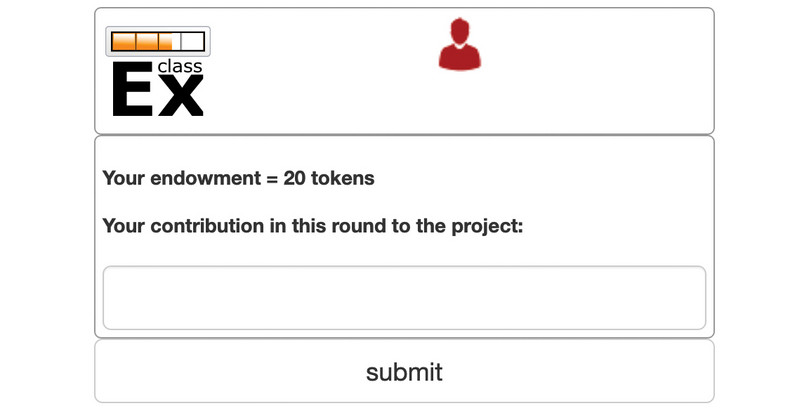
Figure A The classEx contribution screen
After all the members of your group have contributed, you will receive feedback on the total contribution to your project and on the tokens you gained in that round (your ‘income’), as well as the number of tokens you have accumulated so far (Figure B).
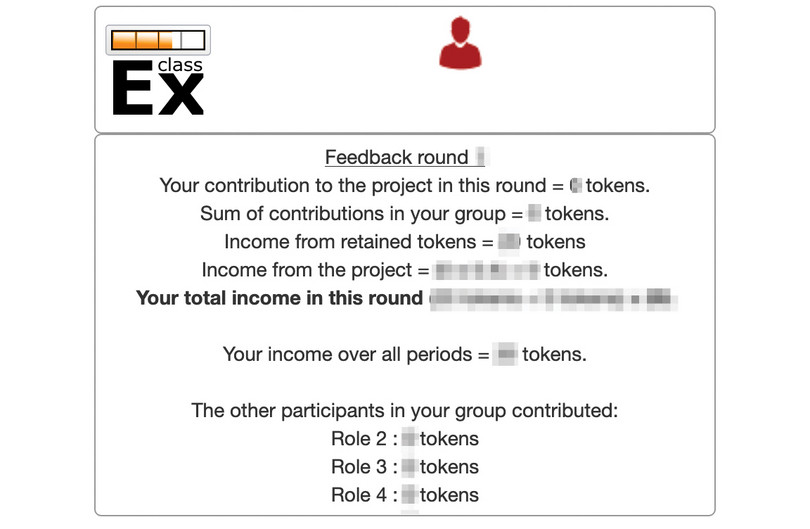
Figure B The classEx feedback screen
Your reward or payoff will be your final accumulated income at the end of the 10 rounds. Your income in each round consists of the number of tokens you kept for yourself plus 0.4 times the total number of tokens contributed to the project. That is:
\[\text{Income in a round} = (20 − \text{tokens you contribute}) + \\ 0.4 \times \text{total contribution to the project}\]This is because the project produces 1.6 tokens for each token contributed, and all members of the group receive the same return from the project (1.6/4 = 0.4). For example, if the total contribution is 60 tokens, then you and all other members of the group receive 60 × 0.4 = 24 tokens from the project. If you had contributed 15 tokens, then your income in that round would be (20 − 15) + 24 = 29 tokens. If, on the other hand, you had contributed 5 tokens to the project, your income in that round would be (20 − 5) + 24 = 39 tokens.
Remember, your reward or payoff will depend exclusively on your total income.
Remember, all your decisions must be kept private. You must not communicate with other students nor make public announcements, no matter how tempting it might become.
It is very important that you abide by the following rules: All your decisions must be kept private. You must not communicate with other students nor make public announcements, no matter how tempting it might become.
You can use the following questions to test your understanding of the rules.
- Each group member has 20 tokens. Suppose that the other three members of your group contribute nothing to the project.
- What is your income if you contribute nothing?
- What is your income if you contribute 20 tokens?
- Each group member has 20 tokens. Suppose that the other three members contribute 12 tokens in total to the project (excluding your own contribution).
- What is your income if you contribute 20 tokens?
- What is your income if you contribute 0 tokens?
- Each group member has 20 tokens. Suppose that you contribute five tokens to the project.
- What is your income if the total contribution to the project (including yours) is 12 tokens?
- What is your income if the total contribution to the project (including yours) is 48 tokens?
-
- 20
- 8
-
- 12.8
- 24.8
-
- 19.8
- 34.2
4.8 Homework questions
Remember that each participant receives 20 tokens in each round.
- Assume the other three participants in your group are contributing everything in the first round.
- What is your payoff if you contribute everything?
- What is the total payoff in this case for all participants?
- What is your payoff if you contribute nothing?
- What is the total payoff in this case for all participants?
- Now let’s assume the other three participants are contributing 10 tokens in the first round.
- Answer questions 1a–d again.
- What can you conclude about the statement ‘My expectation of the contributions of others’ does not matter in the public goods game.’
- Free riders
Hint: For question 3, which values do you have to change to make it not a social dilemma?
- Describe what is meant by ‘social dilemma’ and ‘free rider’.
- What parameters of the game are responsible for the social dilemma?
4.9 Further reading
- ‘Games people play’ (The Economist, 20 January 2015) explains how the proportion of self-interested, cooperators and reciprocators can determine the equilibrium outcome (based on Kurzban, Robert and Houser, Daniel. 2025. ‘Experiments investigating cooperative types in humans: A complement to evolutionary theory and simulations’. PNAS 102 (5): pp. 1803-1807).
- ‘The usefulness of managers’ (The Economist, 13 October 2019) presents a variation of the game to study the influence of managers in the contribution to public goods (based on Billinger, Stephan and Rosenbaum, Stephen M. 2029. ‘Discretionary mechanisms and cooperation in hierarchies: An experimental study’. Journal of Economic Psychology 74).
- Henrich, Joseph et al. 2006. ‘Costly Punishment Across Human Societies’. Science 312 (5781): pp. 1767-1770 shows that punishing deviators is a common feature in all societies. Although punishments vary across societies, more altruistic groups are more willing to pay the cost of punishing non-cooperators.
- CORE The Economy 2.0: Microeconomics, Section 4.8.
- CORE The Economy 1.0, Section 4.7.
- CORE Economy, Society, and Public Policy, Section 2.9.
