
Unit 9 The conflict game
When should people be competitive and when should they cooperate with each other to get a better result? This experiment addresses questions of cooperative and competitive behaviour. It also helps students understand basic concepts of game theory, including a Nash equilibrium, and how incentives affect individuals’ bargaining decisions.
CORE projects
Concepts in the experiment are related to the material in:
9.5 Student instructions
Introduction
In this game, you will play five rounds. In each round, you will be randomly matched with another student. Both of you will have to decide simultaneously how to behave in negotiating a deal worth 2000: cooperatively (as a Dove) or aggressively (as a Hawk). At the end of the round, you will receive a payoff according to the information in the payoff matrix (see Figure A for an example).
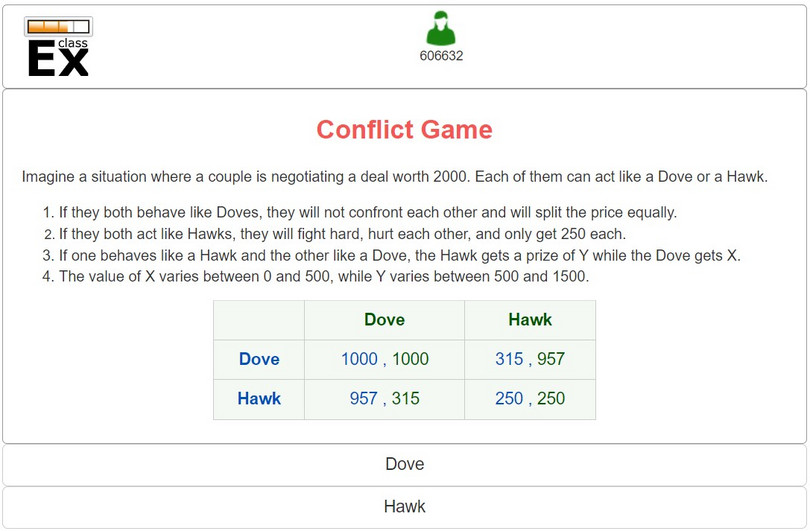
Figure A Students’ screen for a realization of \(X=315\) and \(Y=957\).
Observe that in each round, you might play with a different student who will be randomly selected from all participants. Sometimes you will be the Blue player, and at other times the Green player. Finally, recall that you will both decide simultaneously and play five rounds.
Profits
Profits are calculated using the two variables, \(X\) and \(Y\). The value of \(X\) will always be a random number between 0 and 500, and that of \(Y\) will be a random number between 500 and 1500. They will take a different value at the beginning of each round. Participants will know the round’s value before they decide.
Note that there are three possible payoff combinations. At the end of the experiment, you will earn the sum of the profits of all the rounds.
- If both students in the pair behave as a Dove, they will not fight and will therefore split the 2000 prize equally.
- If both behave as a Hawk, they will fight fiercely, hurting each other and getting only 250 each.
- If one behaves as a Hawk and the other as a Dove, then the Hawk gets a prize of \(Y\), while the Dove gets \(X\).
Figure B shows this explanation and other details that will be shown on your instructor’s screen.
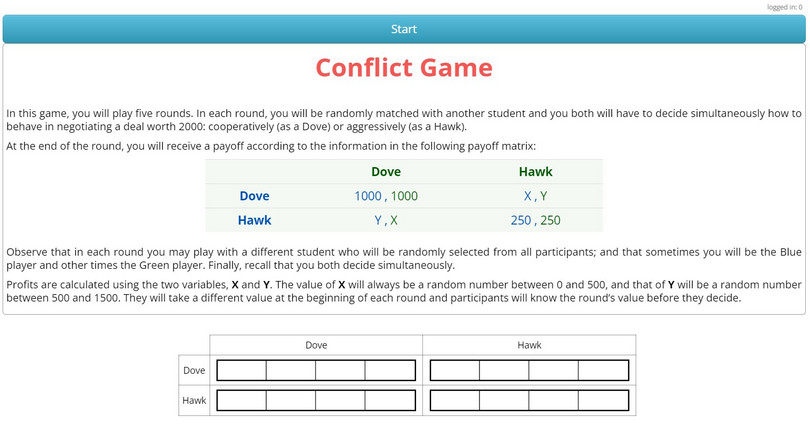
Figure B Instructor screen.
9.8 Homework questions
The conflict game
There are two players: Blue and Green. Blue will choose between Dove and Hawk and Green between Dove and Hawk. Both will make their decision simultaneously. The payoffs are represented in Figure C. In addition, there are two variables, \(X\) and \(Y\). The value of \(X\) will always be a number between 0 and 500, and the value of \(Y\) will always be a number between 500 and 1500.
| Dove | Hawk | |
|---|---|---|
| Dove | 1000 , 1000 | X , Y |
| Hawk | Y , X | 250 , 250 |
Figure C Payoff matrix.
- Represent the following four games in normal form and then find the Nash equilibria:
- \(Y\) < 1000 and \(X\) > 250
- \(Y\) < 1000 and \(X\) < 250
- \(Y\) > 1000 and \(X\) > 250
- \(Y\) > 1000 and \(X\) < 250.
- Represent the above four games in their extensive (sequential) form with perfect information and find the perfect Nash equilibrium in subgames.
- Clearly define a way to measure conflict in this game by a quantitative variable. Explain your answer.
9.9 Further reading
- ‘The Disturbing New Relevance of Theories of Nuclear Deterrence’ (The Economist, 18 March 2022) describes how Schelling’s game-theoretic analysis helps to understand the conflict in Ukraine and the nuclear brinkmanship between Russia and the West.
- ‘What the Protracted Game of Chicken Over First Republic Tells Us’ (Financial Times, 1 May 2023) uses the game of chicken to explain the protracted stand-off between the two banks, where each side hopes the other will blink first and give up or compromise.
- Schelling, Thomas C. 1956. ‘An Essay on Bargaining’. The American Economic Review 46 (3): pp. 281-306 presents a theory of conflict and cooperation.
- Baliga, Sandeep and Sjöström, Tomas. 2012. ‘The Strategy of Manipulating Conflict’. American Economic Review 102 (6): pp. 2897-2922 presents the original 2×2 conflict game.
- Palacio, Luis A., Cortés-Aguilar, Alexandra, and Muñoz-Herrera, Manuel. 2015. ‘The Strategic Role of Nonbinding Communication’. Journal of Applied Mathematics 910614 extensively discusses the conflict game, where the discussion of the Nash equilibrium concept is addressed in different bargaining contexts.
