
How to use Experiencing Economics
Experiencing Economics is designed to provide you with preprogrammed experiments that can be run immediately, plus a complete set of materials to help you maximize the benefits of using experiments in your teaching. In this section, we will explore the contents of the book, different ways you can use the experiments, and how to get started with classEx, the free online platform used to run them.
The content
Experiencing Economics provides step-by-step guides for running economics experiments as well as several features to help you relate the experiments to the theory, questions, and conclusions economics has to offer. Experiment 1: Getting started with simple experiments is intended to introduce instructors to using experiments in their teaching. It provides practical suggestions on how to start using experiments, tips for running experiments, and step-by-step instructions for four simple games that serve as a good starting point. The remaining chapters each present one experiment. They all share the same structure, which facilitates the learning process, and include the following features:
- An introduction presents a real world question and the key concepts that the experiment aims to cover. It provides a description and requirements of the experiment, and links to the relevant units in The Economy and, where applicable, Economy, Society, and Public Policy.
- Detailed step-by-step instructions for running the experiment provides all the information you need to run the experiment and allows you to get started straight away.
- Student instructions offers stand-alone instructions that can be sent to your students.
- Predictions shows graphical results from previously run sessions and provides theoretical predictions as well as alternative outcomes, helping you to be prepared for your session.
- Topics for discussion and homework questions helps frame the discussion following the experiment and ensures that students get the best from their experience.
- Further reading develops students’ understanding about the experiment and the topic.
- Instructor experience offers a first-hand description of the instructors’ experiences running the experiment and their personal uses and tips.
If you are interested in a deeper understanding of the nuts and bolts, the optional Advanced settings section explains the experiment’s internal design and shows how you can personalize each experiment for your class needs.
Uses of Experiencing Economics
All experiments in Experiencing Economics are self-contained and can be used in any sequence. They can be run independently of each other, which allows for flexibility across different types of courses and teaching styles. Several examples are presented below. For those new to this approach, or anyone looking for practical advice on incorporating experiments into their teaching, Experiment 1 provides pathways to help you and your students get comfortable with this interactive format.
Introductory course
A course providing an introduction to economics is an ideal setting to expose students to the real-life decision-making process through experiments. If you use the CORE-econ books, each experiment links to the relevant units in the first and second editions of The Economy and, when appropriate, to the units in Economy, Society, and Public Policy. However, these experiments are also valuable to instructors using other textbooks. Remember, the experiments are self-contained and can be used in any order. Participating in the experiments helps your students relate economic theory to their personal experiences and develop their economic intuition. Many experiments are also suitable for introductory courses in game theory.
Topic course
Many experiments can also be used in courses with a specific focus, such as environmental economics or public policy, especially if you want to introduce a concept without or before a rigorous theoretical analysis. For example, the tragedy of the commons, the prisoner’s dilemma, or tax incidence are concepts that students understand more easily when experienced through an experiment.
Experimental methodology course
Several experiments are also suitable for an experimental methodology course. The simple games in Experiment 1 highlight the prisoner’s dilemma and the ultimatum game (dictator and trust game are also available in classEx) and provide a starting ground for the discussion of social preferences. The public goods game similarly allows the exploration of second-party punishment. The Coordination Game: Investment illustrates the basic features of coordination games, like multiple equilibria and the need for focal points; it also involves a framing treatment with a between-subject design. Other market games can be used to discuss basic rationality failures.
Macroeconomics course
In a macroeconomic class, you may wish to use the Coordination Game: Investment and the Multiplier Game. After introducing standard individual theories of investment –such as net present value– you can show how these concepts relate to aggregate investment. The Coordination Game: Investment helps students understand that, in a macroeconomy, investment is a coordination game with multiple equilibria. This experiment can illustrate how coordination failures occur and highlight the importance of creating a favourable investment environment. The Multiplier Game directly introduces students to the standard Keynesian cross model (without government), where investment and consumption determine national income. This activity also enables more advanced discussions, such as the Robertson lag, providing opportunities for deeper exploration of macroeconomic concepts.
Other courses
Finally, you can use this book as a foundation to develop experiments that illustrate specific concepts not covered here. Instead of creating instructions, discussion questions, and materials from scratch, you can select a related experiment and modify its content to fit your needs. For example, you might use the templates for a double auction experiment but change the nature of the market shock from a tax to a supply reduction. This flexibility allows you to extend the use of the book to complement a wider range of topics.
The classEx quickstart
The experiments in Experiencing Economics are implemented using the online tool classEx. classEx is a free, widely used online tool developed by the University of Passau. It allows instructors to run interactive experiments in the classroom and during synchronous online teaching.
classEx runs through centralized servers at the University of Passau, so there is no need to install software or download apps. Instructors can run ready-made games and also develop their own games in a standard internet browser. Students log in with their smartphone, tablet, or laptop, either in the classroom or at home, and can participate interactively in the lecture. They only need a standard browser and an internet connection. Results and intuitive graphs are shown instantly on the instructor’s presentation screen.
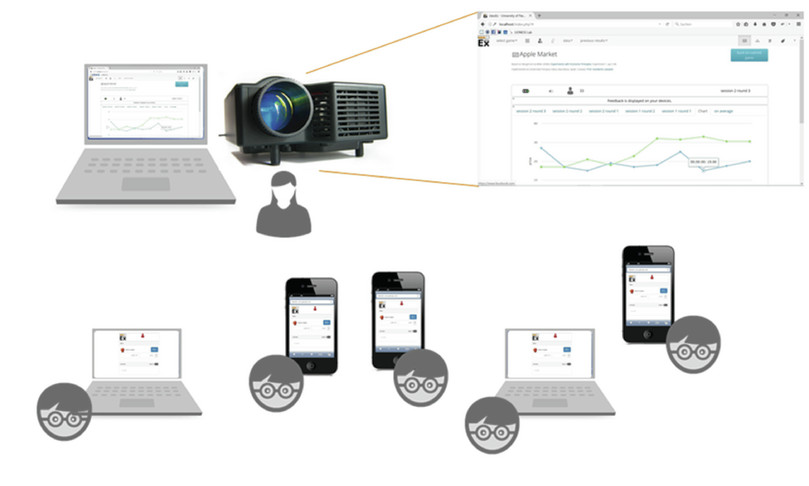
All experiments from this book are available in the folder ‘CORE Experiencing Economics’ in classEx. The easiest way to start using classEx is by reading the ‘how to get started’ and ‘how to run ready-made games’ sections in the classEx documentation. Other sections are not necessary but helpful if you want to get involved in personalizing the experiments or even creating your own.
Requirements
- Instructors and students will need a smartphone, tablet, or computer that has one of the common browsers and is connected to the internet. We suggest using Firefox (note that classEx does not run on Internet Explorer).
- For in-class experiments, we recommend using a projector to help with instructions, results, and discussion.
Registration and login
- Instructors need to register in order to get free login credentials. They log in to classEx as an ‘experimenter/lecturer’.
- Students do not need to register. Instructors provide students with the course password set in the course data page within classEx. Students should log in to classEx as a ‘participant’.
Running the games
To start a game, simply click on the ‘Play’ button next to the game’s name in the classEx webpage. Refer to the corresponding experiment in this book for detailed step-by-step instructions.
