
Climate justice: The intersection of economics, the environment, and inequality
1 Introduction
The Emergency Events database contains estimates of damages caused by hurricanes and other natural disasters. Hurricanes are categorized on a 1-to-5 scale according to their wind speed, so Hurricane Matthew is considered weaker than Hurricane Katrina. For more information about the different hurricane categories, read the Saffir-Simpson Hurricane Scale by the US National Weather Service.
In 2005, a Category 5 hurricane called Katrina struck the United States, causing USD125 billion of damage and killing 1,833 people. Despite being the costliest hurricane in US history, the cost of the damage from Katrina amounted to only 1% of US GDP. In contrast, when a Category 4 hurricane called Matthew landed in Haiti in 2016, it caused damage equal to 28% of Haiti’s GDP. Katrina was the third-deadliest hurricane in US history, but Matthew resulted in a per capita death rate ten times higher than Katrina’s. This level of devastation, which is hard to imagine in high-income countries like the US, lives on in Haiti’s current socio-political turmoil as it exacerbated Haiti’s government failure, widespread violence, and mass emigration.
Read Unit 22 of The Economy 1.0 to learn more about government failure and political accountability.
Compared to Haiti, the US was relatively well prepared to deal with Hurricane Katrina, thanks to robust institutions, resilient infrastructure, and greater wealth—much of it built on decades of fossil fuel use. Paradoxically, the same fossil fuel use which helped build US wealth has also generated the emissions driving climate change, and contributing to more intense and costly hurricanes. On the other hand, Haiti’s weak institutions, inadequate infrastructure, and lack of wealth to cope with shocks are linked to low emission levels. In fact, Figure 1 shows that while the US has emitted 13.1% of cumulative global fossil fuel emissions since 1850, Haiti’s share is less than 0.01% (so small it cannot be seen in the chart). Thus, while Haiti has benefitted little from emissions and has contributed next to nothing to creating the problems associated with climate change, it suffers the consequences and is ill-prepared to deal with them.
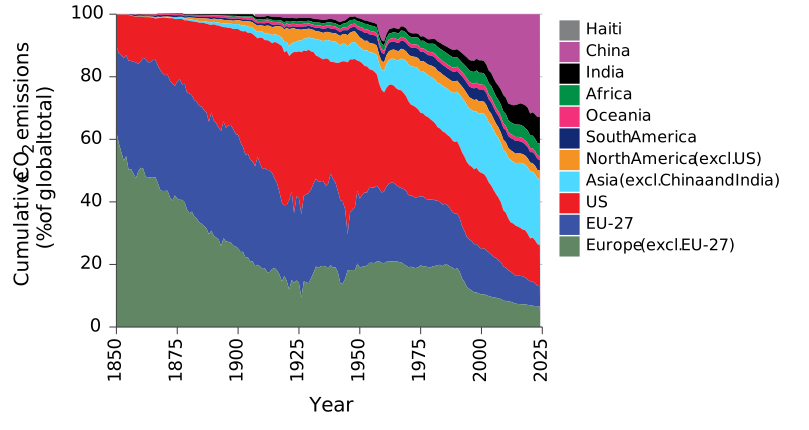
Figure 1 Cumulative CO2 emissions by world region and selected countries (1850–2024).
Global Carbon Budget 2025 (Friedlingstein et al., 2025, ESSD).
This inverse relationship, which we will call the ‘emissions vulnerability paradox’, is not unique to the US and Haiti, as it can be found in multiple regions of the world: countries that are the least responsible for causing climate change are the most vulnerable to its effects, and vice versa. The emissions vulnerability paradox is evident also between high- and low-income groups within countries, reflecting a profound link between emission and income inequality that will be discussed further in Section 2.
To learn more about climate justice, read the Intergovernmental Panel on Climate Change’s (IPCC) Sixth Assessment Report and Robinson & Shine (2018). The IPCC defines climate justice as ‘a basis for understanding how the impacts and responses to climate change, including costs and benefits, are distributed in and by society in more or less equal ways. Often aligned with ideas of equality, fairness and justice and applied with respect to equity in the responsibility for, and distribution of, climate impacts and policies across society, generations and gender, and in the sense of who participates and controls the processes of decision-making’.
- government failure
- A failure of political accountability. (This term is widely used in a variety of ways, none of them strictly analogous to market failure, for which the criterion is simply Pareto inefficiency.)
- emissions vulnerability paradox
- The situation in which those who contribute least to climate change are often the most affected by its consequences and the least equipped to cope with them, and vice versa.
- climate justice
- A framework that recognizes the unequal responsibilities and impacts of climate change across different populations and emphasizes fairness in addressing these inequalities.
The concern over the emissions vulnerability paradox has led to increasingly stronger voices calling for climate justice, which refers to fairness in how the impacts of climate change and climate change policies are distributed across societies, across groups in society, and across generations. This approach also aims to ensure fairness in who can participate in and have control over decision-making processes related to climate change.
The emissions vulnerability paradox underlies many of the challenges that exist in dealing with climate change: the most climate-vulnerable countries, that have the strongest incentives to cut impacts, are small and economically weak, limiting their power in climate negotiations. In contrast, high-income countries have relatively weaker incentives to make strong climate change commitments or even participate in these commitments (despite bearing a greater responsibility over historical emissions), because they are less vulnerable to climate change and benefit more from current emissions.
This imbalance is evident in annual international meetings focused on climate change (known as the Conference of the Parties, or COP). High-income countries participate with large delegations of dozens of experts who can attend the multiple negotiation rooms running in parallel, with English-only discussions, while low- and middle-income countries are represented by small delegations that must decide which topics to attend, so they are often forced to miss important discussions of relevant issues, particularly when the meetings are extended overnight. This problem has prompted the development of international partnerships, such as The High Ambition Coalition in 2015 and the Climate Vulnerable Forum in 2020, which have been successful in increasing climate action ambitions (discussed in Section 5). However, their pressure has not been enough to deliver effective climate justice.
This Insight will explore the various dimensions of inequality involved in global climate negotiations and how these influence the key issues under debate. Using the principles of climate justice, this Insight will also discuss how decision-makers can design responses to climate change that are fair and inclusive.
