Climate justice: The intersection of economics, the environment, and inequality

2 Inequality in emissions

The responsibility for emissions of greenhouse gases is not shared equally. There are stark differences both between countries and between different groups within countries. These are mostly due to income levels and consumption patterns, as higher income is associated with higher consumption and higher emissions, mediated by culture and lifestyle choices.

Within and between regions

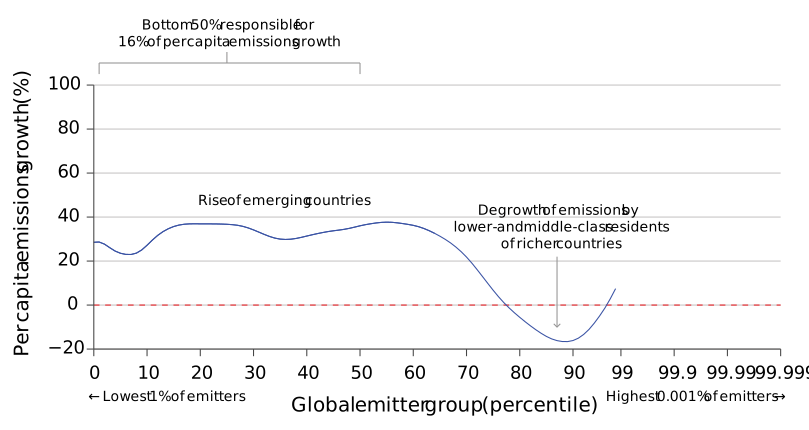
Figure 2 shows the diverse per capita greenhouse gas emission profiles of six world regions and three income groups within each region for the year 2019. Two facts stand out in this figure:

  • Between regions, North America has by far the largest emissions per person for each income group. Not only do the top 10% of North Americans emit 72% more than the top 10% of East Asians (the second-largest emitters), but also the middle 40% in North America emits more than the top 10% in Latin America, South and Southeast Asia, and sub-Saharan Africa. Even the bottom 50% of North Americans emit more than the top 10% in sub-Saharan Africa.
  • Within regions, the top 10% of the income distribution emits considerably more per person than the middle 40% and bottom 50%, although the extent of this inequality does not vary systematically with the level of emissions. In MENA (Middle East and North Africa) and sub-Saharan Africa, the top 10% emits roughly 15 times more than the bottom 50%, while in North America this ratio is 6.6 times more.

Tons of CO2 equivalent, or tCO2e, expresses the warming impact of all greenhouse gases using a common scale. Each gas is converted into the amount of CO2 that would cause the same warming, using a measure called global warming potential (GWP). GWP compares how much heat a gas traps in the atmosphere relative to CO2, which has a GWP of 1. For example, methane has a GWP of around 28, meaning that 1 ton of methane warms the planet as much as 28 tons of CO2, so it is counted as 28tCO2e.
In this grouped bar chart, the vertical axis shows the greenhouse gas emissions in tons of CO2 equivalent per capita per year, with a scale from 0 to 70. The horizontal axis shows eight different world regions. In the chart, each region has three bars for different income groups: for the bottom 50%, for the middle 40%, and for the top 10%. North America shows the highest total emissions of tons of CO2 equivalent per capita per year, dominated by the top 10% income group(68.8) and middle 40% (21.8), with the bottom 50% at 10.4. East Asia follows, with the top 10% at 40, the middle 40% at 7.9, and the bottom 50% at 2.9. Russia and Central Asia show the top 10% at 36, the middle 40% at 10.1, and the bottom 50% at 4.5. Europe has the top 10% at 29.4, the middle 40% at 10.7, and the bottom 50% at 5. The Middle East and North Africa (MENA) have the top 10% at 33.8, the middle 40% at 7.3, and the bottom 50% at 2.2. South and South-East Asia show the top 10% at 11.2, the middle 40% at 2.4, and the bottom 50% at 0.9. Sub-Saharan Africa shows the top 10% at 7.5, the middle 40% at 1.7, and the bottom 50% at 0.5. Latin America shows the top 10% at 17.8, the middle 40% at 4.8, and the bottom 50% at 2.
Fullscreen
https://books.core-econ.org/insights/climate-justice/02-inequality-in-emissions.html#figure-2

Figure 2 Carbon footprints per person, by region (2019).

Figure 4 in Chancel, Bothe, and Voituriez. 2023. Climate Inequality Report 2023.

Exercise 1 Your carbon footprint

  1. Use this carbon footprint calculator to calculate your carbon footprint. (Select the country you live in to receive more tailored feedback on your answers.) Pay attention to the questions used to calculate a person’s carbon footprint.
  2. Compare your carbon footprint with the numbers in Figure 2. Which groups/regions is your carbon footprint similar to?
  3. Based on how the carbon footprint was calculated, suggest some specific reasons for the differences between regions and within populations.
Theil index
An inequality metric derived from information theory that decomposes inequality into within-group and between-group components.

The extent of within-country and between-country emissions inequality has changed considerably over the past 35 years. To measure this inequality, we use the Theil index, which ranges from 0 (or 0%, indicating perfect equality) to 1 (or 100%, indicating maximum inequality). The ‘Find out more’ box below explains how to calculate the Theil index, its decomposition property, and why it is useful as a measure of inequality.

To learn more about global trends in income inequality, read Section 19.1 of The Economy 1.0.

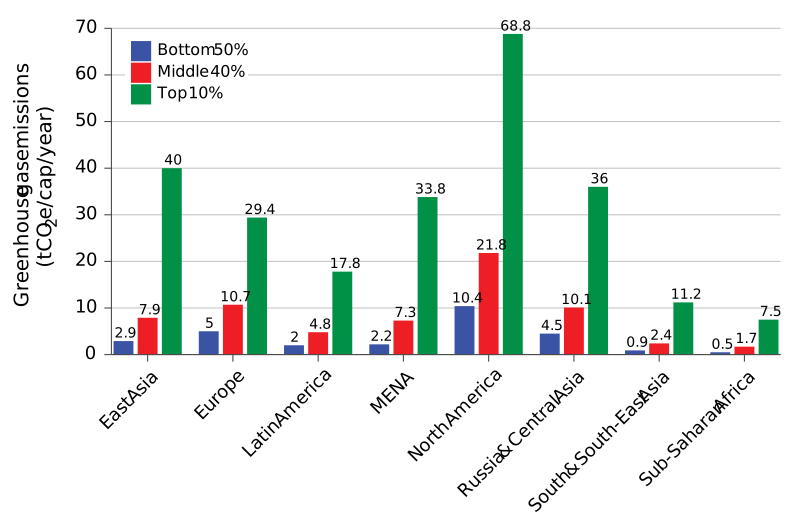
Figure 3 shows that according to this measure, in 1990 almost two-thirds of the inequality in emissions was due to differences between countries compared to one-third of emissions inequality due to differences within countries, but by 2019 those numbers had flipped around. This change has occurred because of forces operating both between countries and within them:

The income elasticity of emissions refers to how much emissions change with income. Mathematically this is defined as \(\frac{\partial E}{\partial I} \times \frac{I}{E}\), where \(E\) are emissions and \(I\) is income. If \(\frac{\partial E}{\partial I} \times \frac{I}{E}> 0\), an increase in income leads to an increase in emissions, and vice versa. A positive income elasticity of less than one means that emissions increase by less (in percentage terms) than income does.

  • Between countries, formerly low-emitting countries (particularly China and India) have rapidly increased emissions as they industrialized, while many high-emitting countries have decreased them (particularly the US, which remains the second biggest emitter, and many European countries).
  • Within countries, rising inequalities in income over the same period has implied rising inequalities in emissions between income groups, given that in all countries the income elasticity of emissions is positive, albeit less than one.1
In this line chart, the vertical axis shows the Theil index of global inequality, ranging from 35% to 65%. The horizontal axis shows years from 1990 to 2020. The chart features two lines: a solid line representing ‘between-country’ inequality and a dotted line representing ‘within-country’ inequality. In 1990, between-country inequality accounted for approximately 62% of global carbon emissions inequality, while within-country inequality accounted for about 38%. The two lines intersect at around 2007. By 2019, this pattern had reversed: within-country inequality now accounts for approximately 64% of global emissions inequality, while between-country inequality has declined to about 36%.
Fullscreen
https://books.core-econ.org/insights/climate-justice/02-inequality-in-emissions.html#figure-3

Figure 3 Global inequality of individual emissions: between-country vs within-country inequality (1990–2019), using the Theil index of inequality.

Figure D in Chancel, Bothe, and Voituriez. 2023. Climate Inequality Report 2023.

Question 1 Choose the correct answer(s)

What trend is observed when comparing per capita emissions across income groups? Choose the correct option(s).

  • Per capita emissions follow a U-shaped pattern with income.
  • The highest-income individuals emit less due to low-carbon lifestyles.
  • Per capita emissions increase dramatically with income.
  • Lower-income countries emit less per person despite usually using more inefficient technologies.
  • Figure 2 shows that per capita emissions increase with income.
  • Figure 2 shows that per capita emissions increase with income, and the top 10% in the income distribution have the highest emissions.
  • Figure 2 shows that per capita emissions increase with income, and the top 10% in the income distribution have the highest emissions.
  • Figure 2 shows that per capita emissions are lower in regions such as sub-Saharan Africa compared to regions such as North America.

Find out more Measuring inequality: The Theil index and its decomposition property

The Theil index is a measure of economic inequality that helps us understand how unequally something (like income or wealth) is distributed across a group of people. Its key usefulness in the study of climate justice lies not only in quantifying overall inequality, but also in its decomposition property: it can be separated into inequality that occurs within groups (for example, income groups or countries) and inequality that occurs between groups (differences in group averages).

Mathematically, given a population of \(N\) individuals with individual emissions of \(y_i\) and an average emission level of \(\mu\), the Theil index \(T\) is written as:

\[T = \frac{1}{N}\left( \frac{y_{i}}{\mu} \times \ln\left( \frac{y_{i}}{\mu} \right) \right)\]

This formula weighs each person’s contribution to inequality according to how much their emissions deviate from the average: only people who emit exactly the average have zero contribution to inequality.

To decompose this index into within-group and between-group emissions, assume the population is partitioned into \(G\) groups (for example, countries), where group \(g = 1,…, G\) has a population size of \({N}_{g}\), average emissions of \({\mu}_{g}\), and total emissions of \({Y}_{g}\). Then, the Theil index for a particular group \(g\) can be written as:

\[T_{g} = \frac{1}{N_{g}}\left( \frac{y_{i}}{\mu_{g}} \times \ln\left( \frac{y_{i}}{\mu_{g}} \right) \right)\]

Moreover, consider that \(\mu\) and \(Y\) are average and global total emissions, respectively. Then the Theil index \(T\) can be rewritten as:

\[T = T_W + T_B\]

where

\[T_W = \sum_{g=1}^G \frac{Y_g}{Y} T_g\]

represents within-group emissions inequality and

\[T_B = \sum_{g=1}^G \frac{Y_g}{Y} \ln\left(\frac{\mu_g}{\mu} \right)\]

represents between-group emissions inequality.

Numerical example

Let’s consider a two-country scenario.

  • In country 1, there are two people, with individual emissions of 4 and 6 (so \(N_{1} = 2,\ Y_{1} = 10,\ \mu_{1} = 5\)).
  • In country 2, there are three people, with individual emissions of 2, 2, and 1 (so \(N_{2} = 3,\ Y_{2} = 5,\ \mu_{2} = 5/3 \approx 1.667\)).
  • Globally (adding up or taking averages across countries): \(N = 5\), \(Y = 15\), \(\mu = 3\).

Non-decomposed Theil index (global inequality)

\[\frac{1}{5} \left[ \frac{4}{3}\ln\left(\frac{4}{3}\right) + \frac{6}{3}\ln\left(\frac{6}{3}\right) + \frac{2}{3}\ln\left(\frac{2}{3}\right) + \frac{2}{3}\ln\left(\frac{2}{3}\right) + \frac{1}{3}\ln\left(\frac{1}{3}\right) \right] = 0.173\]

Within-country Theil indices

\[T_1 = \frac{1}{2} \left[ \frac{4}{5}\ln\left(\frac{4}{5}\right) + \frac{6}{5}\ln\left(\frac{6}{5}\right) \right] = 0.02\] \[T_2 = \frac{1}{3} \left[ \frac{2}{1.667}\ln\left(\frac{2}{1.667}\right) + \frac{2}{1.667}\ln\left(\frac{2}{1.667}\right) + \frac{1}{1.667}\ln\left(\frac{1}{1.667}\right) \right] = 0.02\]

Within-country inequality

\[T_W = \frac{Y_1}{Y}T_1 + \frac{Y_2}{Y}T_2 = \frac{10}{15} \times 0.02 + \frac{5}{15} \times 0.044 = 0.028\]

Between-country inequality

\[T_B = \frac{Y_1}{Y} \ln\left(\frac{\mu_1}{\mu} \right) + \frac{Y_2}{Y} \ln\left(\frac{\mu_2}{\mu} \right) = \frac{10}{15} \ln\left(\frac{5}{3} \right) + \frac{5}{15} \ln\left(\frac{1.667}{3} \right) = 0.145\]

Note that since \(T = T_W + T_B\), we can also calculate the Theil index for global inequality by adding the Theil indices for within-country and between-country inequality (which is the same as the non-decomposed Theil index we calculated). The decomposition calculations indicate that 16.2% (0.028/0.173) of global inequality comes from within-country inequality and 83.8% (0.145/0.173) comes from between-country inequality.

Emissions by global income groups

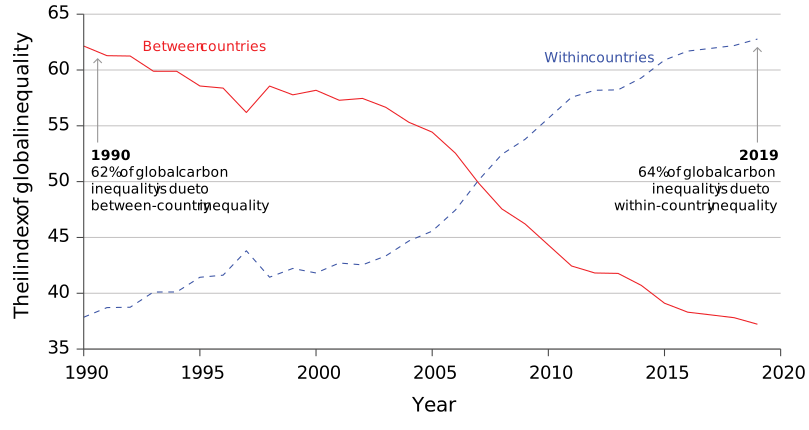
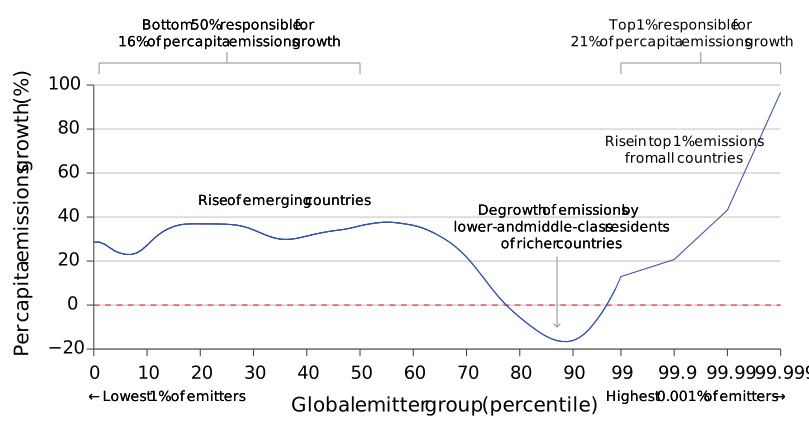
Instead of breaking down the data by national and regional borders, Figure 4 shows per capita emissions growth for percentiles of the global population over the period 1990 to 2019. The combination of within-country and between-country forces described earlier in this section has implied a non-linear growth rate of emissions by percentiles of individual emitters between 1990 and 2019.
Per capita emissions growth by percentile of global emissions distribution (1990–2019).
Fullscreen
https://books.core-econ.org/insights/climate-justice/02-inequality-in-emissions.html#figure-4

Figure 4 Per capita emissions growth by percentile of global emissions distribution (1990–2019).

Figure 5 in Chancel, Bothe, and Voituriez. 2023. Climate Inequality Report 2023.
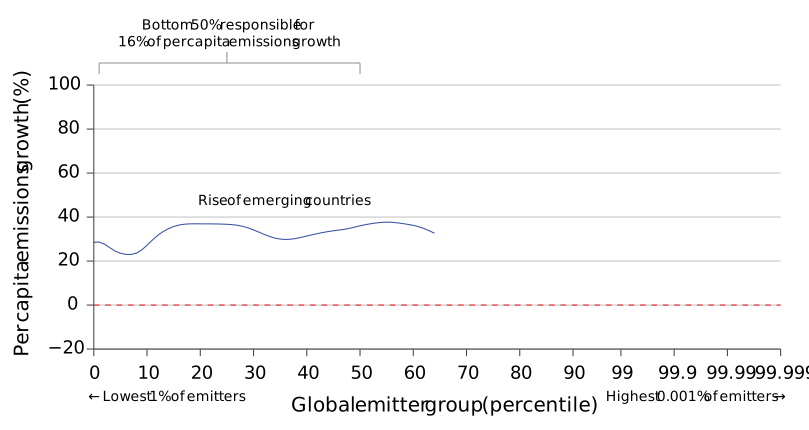
Emissions of the bottom 50%: In this line chart, the vertical axis shows per capita emissions growth in percentages ranging from minus 20% to 100%. The horizontal axis shows global emitter groups by percentile, ranging from 0 (1% lowest emitters) on the left to 99.999th (0.001% highest emitters) on the right. The chart displays a slightly wavy line labelled ‘rise of emerging countries’. It is hovering between approximately 25% and 38% per capita emissions growth for the distribution between the 10th and 65th percentiles (the line is between 22% and 30% for the 0 to 10th percentiles). This represents the bottom 50% being responsible for 16% of per capita emissions growth.
Fullscreen
https://books.core-econ.org/insights/climate-justice/02-inequality-in-emissions.html#figure-4a

Emissions of the bottom 50%

The increase in emissions over the period 1990 to 2019 was similar across all of the bottom 50% of global emitters, at around 35%. This increase corresponds to the economic growth of low- and middle-income countries that started off from a low base value. Similarly, the 50th to 60th percentiles have experienced increases in emissions of around 35%.

Emissions of the 60th to 95th percentiles: In this line chart, the vertical axis shows per capita emissions growth in percentages ranging from minus 20% to 100%. The horizontal axis shows global emitter groups by percentile, ranging from 0 (1% lowest emitters) on the left to 99.999th (0.001% highest emitters) on the right. The chart displays a slightly wavy line labelled ‘rise of emerging countries’. It is hovering between approximately 25% and 38% per capita emissions growth for the distribution between the 10th and 65th percentiles (the line is between 22% and 30% for the 0 to 10th percentiles). This represents the bottom 50% being responsible for 16% of per capita emissions growth. At approximately the 60th percentile, the line peaks slightly around 38% before beginning to decline. Between the 70th and 90th percentiles, the line drops steadily, reaching approximately 18% at the 90th percentile. This section is labelled ‘degrowth of emissions by lower- and middle-class residents of richer countries’. After the 90th percentile, the line rises steeply, climbing from negative values back through zero and reaching approximately 10% at the 99th percentile.
Fullscreen
https://books.core-econ.org/insights/climate-justice/02-inequality-in-emissions.html#figure-4b

Emissions of the 60th to 95th percentiles

The 60th to 75th percentiles of emitters have slightly lower (but still positive) growth in emissions. Between the 75th and 95th percentiles, emissions decreased (negative growth) with the largest decrease of nearly 20% experienced by the 88th to 89th percentiles. This pattern corresponds to the degrowth (decrease) of emissions of the low- and middle-income groups within high-income countries.

Emissions of the top 5%: In this line chart, the vertical axis shows per capita emissions growth in percentages ranging from minus 20% to 100%. The horizontal axis shows global emitter groups by percentile, ranging from 0 (1% lowest emitters) on the left to 99.999th (0.001% highest emitters) on the right. The chart displays a slightly wavy line labelled ‘rise of emerging countries’. It is hovering between approximately 25% and 38% per capita emissions growth for the distribution between the 10th and 65th percentiles (the line is between 22% and 30% for the 0 to 10th percentiles). This represents the bottom 50% being responsible for 16% of per capita emissions growth. At approximately the 60th percentile, the line peaks slightly around 38% before beginning to decline. Between the 70th and 90th percentiles, the line drops steadily, reaching approximately 18% at the 90th percentile. This section is labelled ‘degrowth of emissions by lower- and middle-class residents of richer countries’. After the 90th percentile, the line rises steeply, climbing from negative values back through zero and reaching approximately 10% at the 99th percentile. The line then rises to 20% at the 99.9th percentile, to 40% at the 99.99th percentile, and to approximately 98% for the 99.999th percentile. This section is labelled ‘rise in top 1% emissions from all countries’. The section between the 99th and 99.999th percentiles shows that the top 1% are responsible for 21% of per capita emissions growth.
Fullscreen
https://books.core-econ.org/insights/climate-justice/02-inequality-in-emissions.html#figure-4c

Emissions of the top 5%

The top 5% of emitters have substantially increased emissions, with a particularly large increase for the top 0.001%, whose emissions have nearly doubled (close to 100% growth).

Figure 5 shows the resultant degree of global emissions inequality in 2019, measured in tons of CO2 equivalent (tCO2e). This measure is a standard unit that converts all greenhouse gas emissions into their equivalent amount of CO2.

From analysing the absolute and relative emissions of the bottom 50%, middle 40%, top 10%, and top 1%, two facts stand out:

  • In absolute terms, emissions grow exponentially towards the top of the income distribution. While the bottom 50% of the global population averaged yearly emissions of 1.4 tCO2e/capita in 2019, the emissions of the top 1% averaged 101 tCO2e/capita, which is 72 times greater.
  • In relative terms, emissions follow a 50:10 rule. The bottom 50% of the global population emits roughly 10% of global emissions while the top 10% emits roughly 50% of global emissions.
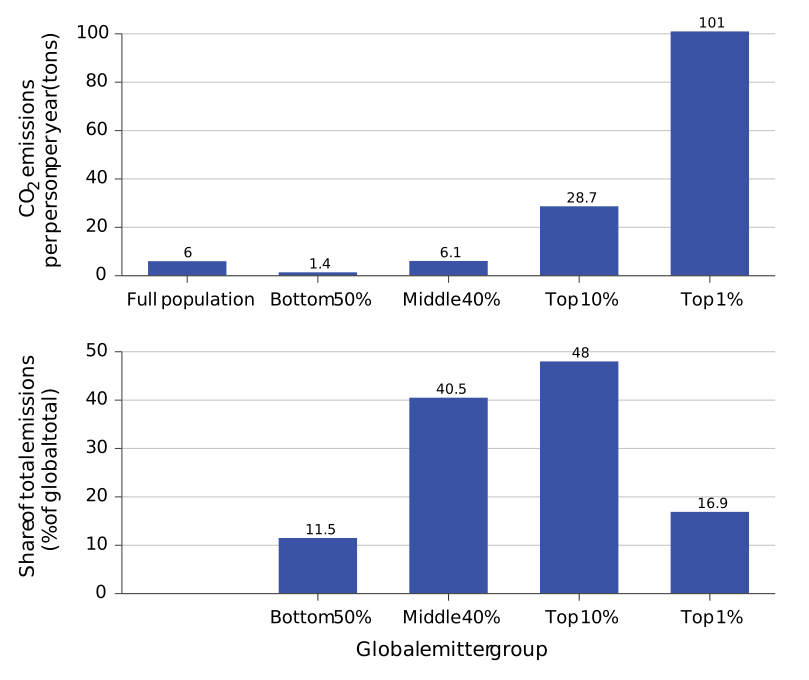
The top panel is a bar chart. The vertical axis shows CO2 emissions per person per year in tons, ranging from 0 to 100. The horizontal axis shows five income groups from left to right: the full population, the bottom 50%, the middle 40%, the top 10%, and the top 1%. The bars show that the full population emits 6 tons of CO2 per person per year, the bottom 50% 1.4 tons, the middle 40% 6.1 tons, the top 10% 28.7 tons, and the top 1% emits 101 tons. The bottom panel is a bar chart. The vertical axis shows the share of total emissions as a percentage of the global total, ranging from 0% to 50%. The horizontal axis shows four income groups from left to right: the bottom 50%, the middle 40%, the top 10%, and the top 1%. The bars show that the bottom 50% accounts for 11.5% of global emissions, the middle 40% for 40.5%, the top 10% for 48%, and the top 1% accounts for 16.9%.
Fullscreen
https://books.core-econ.org/insights/climate-justice/02-inequality-in-emissions.html#figure-5

Figure 5 2019 greenhouse gas emissions (top panel) and shares in world total (bottom panel), by global emitter group.

Figure 3 in Chancel, Bothe, and Voituriez. 2023. Climate Inequality Report 2023.

To explore more data on the relationship between income and emissions, visit Our World in Data’s ‘Global inequalities in CO2 emissions’ webpage.

Exercise 2 Calculating inequality

Note: To do this exercise, you should be familiar with using Lorenz curves to calculate the Gini coefficient. These concepts are covered in Section 2.2 of The Economy 2.0: Macroeconomics.

  1. Use the information in the top panel of Figure 5 to calculate the Theil index in greenhouse gas emissions. Provide a one-sentence interpretation of your answer. (The formula for the Theil index is in the ‘Find out more’ box earlier in this section. Remember that each emitter group is a different size.)
  2. Draw a Lorenz curve for greenhouse gas emissions, with the cumulative share of the population on the horizontal axis and the cumulative share of emissions on the vertical axis.
  3. Using your Lorenz curve from Question 2, calculate and interpret the Gini coefficient. What information does the Lorenz curve and Gini coefficient provide that the Theil index does not?

Question 2 Choose the correct answer(s)

Read the following statements about the ‘50:10 rule’ and choose the correct option(s).

  • The bottom 50% of the world’s population produces 10% of global emissions.
  • The top 10% of the world’s population produces 50% of global emissions.
  • 50 countries are responsible for 10% of global emissions.
  • 10% of the world’s poorest countries emit 50% less than the global average.
  • This statement is shown in Figure 5.
  • This statement is shown in Figure 5.
  • The 50:10 rule refers to percentiles of the global population, not a specific number of countries.
  • The 50:10 rule refers to the distribution of global emissions, and does not make comparisons to global averages.

Emissions per country

Global actions to address climate change have been historically negotiated by country delegations under the Conferences of the Parties (COP), which are part of the United Nations Framework Convention on Climate Change (UNFCCC). The UNFCCC is an international environmental treaty to combat climate change by limiting average global temperature increases. Given this international jurisdiction, a recognition of the importance of country-level emissions inequalities is crucial in order to understand the responsibilities, alliances, demands, and bottlenecks in negotiations.

Figure 6 shows that from 1950 to 2005, the US was the largest emitter, but China has taken the lead since then. In 2023, 20 countries accounted for 80% of global emissions, and the other 194 shared the remaining 20%. In fact, the eight top-emitting countries accounted for 66% of emissions, with China, the US, and India responsible for 31.5%, 13.0%, and 8.1% of total emissions respectively. On the other hand, the bottom 112 countries accounted for only 1% of the total. This makes the US and China the two key players for climate negotiations, given both their contribution to the problem and their economic and technological capacity to deal with it.
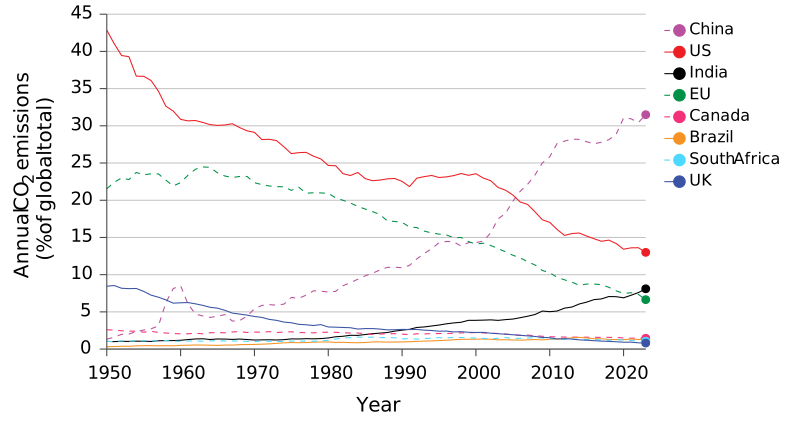
In this line chart, the vertical axis shows annual CO2 emissions as a percentage of the global total, ranging from 0% to 45%. The horizontal axis shows years from 1950 to 2023. The chart displays multiple lines representing China, the US, India, the EU, Canada, Brazil, South Africa, and the United Kingdom. In 1950, the US had the highest share of emissions at approximately 43%, followed by the EU with approximately 22% and the United Kingdom with approximately 9%. Other countries were all below 3%. Over the decades, the US emissions declined but remained the highest until 2005 when they were surpassed by China. In 2023, the US share was approximately 13%. China’s share rose steadily until 2001, then rose sharply between 2001 and 2011, and then kept rising more slowly. In 2023, China’s share of emissions was approximately 32%. The EU’s share declined steadily after the 1970s and in 2023 was at approximately 6%. India’s share remained stable until the 1980s, when it started slowly rising. In 2023, India’s share was approximately 8%. The United Kingdom’s share steadily declined from 1950 and in 2023 stood at below 1%. The share of emissions of Canada, Brazil, and South Africa in 2023 is around 1% each.
Fullscreen
https://books.core-econ.org/insights/climate-justice/02-inequality-in-emissions.html#figure-6

Figure 6 Share of annual CO2 emissions by country (1950–2023).

Our World in Data. Cumulative CO2 Emissions by World Region.

One of the bottlenecks in climate negotiations is the contrast between total and per capita emissions. Although China is by far the largest emitter, it is also the second most populous country, thus making its per capita emissions considerably lower than those of the US and Canada (Figure 7). This issue was especially contentious in climate change negotiations in the past, as China argued that it had the right to pollute so it could develop on par with high-income countries’ standards of living. However, this argument has become less important as China’s per capita emissions grew rapidly after the year 2000 and has far surpassed many European countries. This tension between total and per capita emissions is still relevant to other low- and middle-income countries with high total emissions and low per capita ones, especially India, which ranks third in global emissions but is far below the world average of per capita emissions given that it is the most populous country. Six small, oil-producing countries rank among the top per capita emitters (Qatar, Bahrain, Kuwait, Trinidad and Tobago, Brunei, United Arab Emirates​), with per capita emissions above those in the US and Canada.
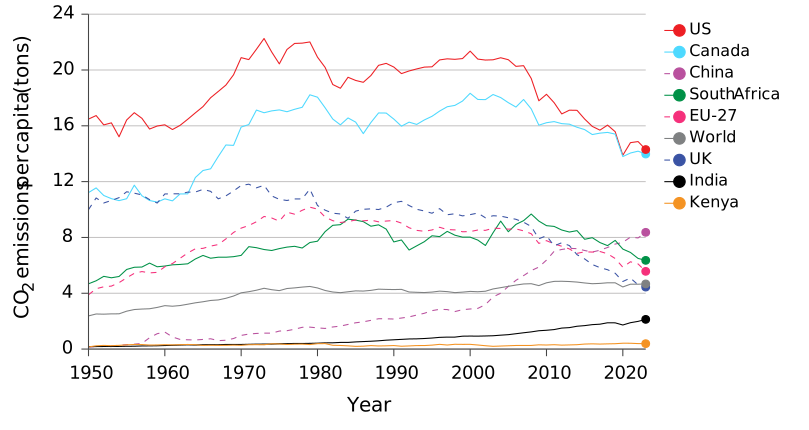
In this line chart, the vertical axis shows CO2 emissions per capita ranging from 0 to 24 tons. The horizontal axis shows years from 1950 to 2023. The chart displays multiple lines representing the US, Canada, China, South Africa, the EU-27, the world, the United Kingdom, India, and Kenya. The US shows the highest per capita emissions throughout the period, starting at around 16 tons in 1950, rising to a peak of approximately 22 tons in the early 1970s, maintaining that level to the 2000s, and then declining to approximately 14 tons in 2023. Canada follows a similar pattern, starting at around 11 tons in 1950, rising to approximately 18 tons in the late 1970s, maintaining high levels, and then declining to approximately 13 tons in 2023. The EU-27 began at around 4 tons in 1950, rose steadily to peak at approximately 10 tons around 1980, then gradually declined to approximately 5 tons in 2023. China remained at under 1 ton until the 1970s, then rose gradually through to about 3 tons in the 1990s, before accelerating after 2000, reaching approximately 9 tons in 2023. South Africa started at around 5 tons in 1950, rose to a peak of approximately 10 tons around 2010, then declined to approximately 7 tons in 2023. The United Kingdom started at around 10 tons in 1950, remained relatively stable with fluctuations until the late 1990s, and then declined to approximately 5 tons in 2023. India remained below 1 ton until the early 1980s, when it began a slow rise to approximately 2 tons in 2023. Kenya remained consistently low throughout the period at below 1 ton. The world average began at around 2 tons in 1950, rose to 4 tons in the early 1970s, and then remained at between 4 and 5 tons for the remainder of the period, with only slight fluctuations.
Fullscreen
https://books.core-econ.org/insights/climate-justice/02-inequality-in-emissions.html#figure-7

Figure 7 Per capita CO2 emissions by country (1950–2023).

Our World in Data. Cumulative CO2 Emissions by World Region.

cumulative emissions
The total greenhouse gas emissions produced over a specific time period, often used to assess historical responsibility for climate change.

Another bottleneck in climate negotiations is the fact that greenhouse gases are generally long-lived and accumulate over time, making cumulative emissions a more direct measure of a country’s responsibility for climate change than current annual emissions (Figure 8). From this perspective, the US and China are the two individual countries that dominate with 23.8% and 15.0% of total emissions in 2023 respectively, with the US’s share decreasing steadily and China’s share increasing steadily since 1950. (The EU-27 group of countries has the second-largest share globally, but this share has been steadily decreasing since 1950.) In 2023, Russia, Germany, and the UK follow behind with 6.7%, 5.2%, and 4.4% of cumulative emissions respectively, while India only accounts for 3.5%. In comparison, the entire group of lower-middle-income countries (using the World Bank’s country classifications) only represent 6.2% of total cumulative emissions (apart from India, these countries are not shown in Figure 8).
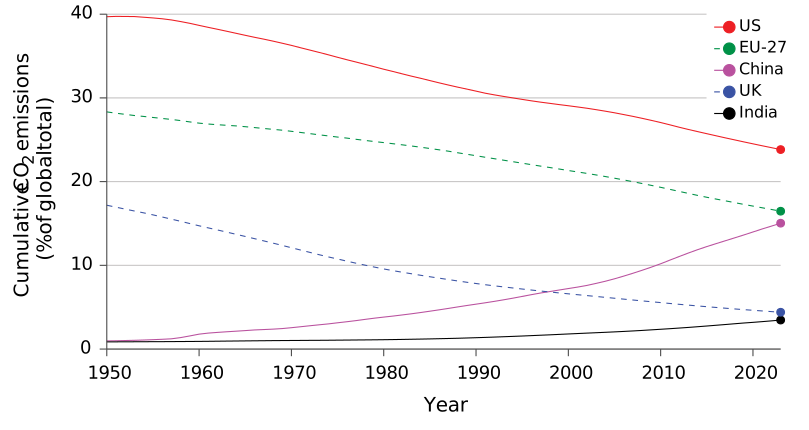
In this line chart, the vertical axis shows cumulative CO2 emissions as a percentage of the global total, ranging from 0% to 40%. The horizontal axis shows years from 1950 to 2020. The US had the highest emissions throughout the period, starting at 40% and declining steadily to approximately 24% in 2023. The EU-27 began at around 28% in 1950 and gradually declined to approximately 16% in 2023. The United Kingdom began at about 17% and declined steadily to approximately 4% in 2023. China began at about 1% in 1950 and rose to about 2% in 1960. It then steadily rose to about 7% in the late 1990s, surpassing the United Kingdom, followed by a steeper rise to approximately 15% in 2023. India began at about 1% in 1950, slowly rising to about 2% in the early 2000s, reaching approximately 3% in 2023.
Fullscreen
https://books.core-econ.org/insights/climate-justice/02-inequality-in-emissions.html#figure-8

Figure 8 Share of global cumulative CO2 emissions (1950–2023).

Our World in Data. Cumulative CO2 Emissions by World Region.

To learn more about the Gini coefficient and how it is calculated, read Section 2.2 of The Economy 2.0: Macroeconomics.

Gini coefficient
A measure of inequality of a quantity such as income or wealth, varying from a value of zero (if there is no inequality) to one (if a single individual receives all of it). It is the average difference in, say, income between every pair of individuals in the population relative to the mean income, multiplied by one-half. Other than for small populations, a close approximation to the Gini coefficient can be calculated from a Lorenz curve diagram. See also: Lorenz curve.

For a short summary of the debate over who is responsible for causing and addressing climate change, watch this video by Kurzgesagt.

These distributions of emissions per country can be depicted using the Gini coefficient. The Gini ranges from 0 (perfect equality) to 1 (maximum inequality). Figure 9 shows that, over time, the Gini on current annual emissions shows a U-shaped pattern, with a fast-decreasing Gini from 0.87 in 1950 to 0.67 in 1991 but increasing thereafter to 0.73 in 2023. The Gini on cumulative emissions consistently decreases, starting at a higher value than the Gini for current emissions but eventually reaching similar values from 2010 onwards.
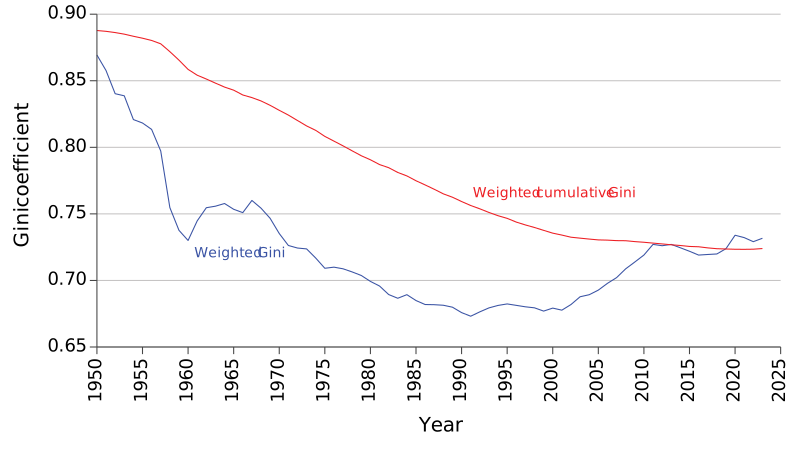
In this line chart, the vertical axis shows the Gini coefficient, ranging from 0.65 to 0.9. The horizontal axis shows the years from 1950 to 2025. The chart displays two lines: a line labelled ‘weighted cumulative Gini’ and a line labelled ‘weighted Gini’. The ‘weighted cumulative Gini’ line starts at approximately 0.89 in 1950 and steadily declines throughout the period to approximately 0.73 in 2023. The ‘weighted Gini’ line starts at approximately 0.86 in 1950, declines sharply to about 0.74 in 1960, then rises to about 0.76 in the late 1960s, and begins declining again to approximately 0.67 in the early 2000s. It then rises to about 0.73 in 2010, stabilises for a while, and rises slightly again to approximately 0.74 in 2020, where it remains.
Fullscreen
https://books.core-econ.org/insights/climate-justice/02-inequality-in-emissions.html#figure-9

Figure 9 Gini of CO2 emissions per country (1950–2023).

Author’s own elaboration with data from Ritchie, Rosado, and Roser. 2023. Per Capita, National, Historical.
Note: ‘Weighted’ means that this measure accounts for the different population sizes of countries. (Larger countries have more ‘weight’, or influence, over the Gini coefficient.)

Question 3 Choose the correct answer(s)

Read the following statements about cumulative emissions and choose the correct option(s).

  • Cumulative emissions are roughly equal across all country income levels.
  • Inequality between countries was historically greater for cumulative emissions than for annual emissions, but since the 2010s the level of inequality has been similar for both.
  • The largest emitting country depends on whether you consider cumulative emissions or current emissions.
  • The US is the highest-emitting country, in terms of both cumulative emissions and current emissions.
  • Figure 8 shows that high-income countries (such as the US) have contributed more to cumulative emissions than low- and middle-income countries.
  • Figure 9 shows that the Gini coefficient for cumulative emissions was initially high (close to 1, or maximum inequality) but has decreased to the same level as the Gini for current emissions since 2010.
  • The US has the highest cumulative emissions, but China has the highest current emissions.
  • The US has the highest cumulative emissions, but Figure 6 shows that China has surpassed the US in current emissions.
  1. Antonin Pottier. 2022. ‘Expenditure Elasticity and Income Elasticity of GHG Emissions: A Survey of Literature on Household Carbon Footprint’. Ecological Economics 192: 107251.