
Climate justice: The intersection of economics, the environment, and inequality
3 Inequality in damages
For more details on how relative damages in Figure 10 were estimated, read page 86 of Chancel, Bothe, and Voituriez’s Climate Inequality Report 2023. While the authors of this report use the term ‘relative losses’, this concept is known elsewhere in the climate change literature and in this Insight as ‘relative damages’.
Figure 10 shows the variation of emissions, relative damages, and capacity to finance (ability to adapt to climate change, measured using personal wealth ownership) between the bottom 50%, middle 40%, and top 10% of global income-earners. Relative damages are crude estimates of how much lower different emission groups’ income would be in 2030 in a ‘business as usual’ scenario relative to a world without climate change. The ‘Find out more’ box explains how damages from climate change can be estimated.
The key fact from Figure 10 is the inverse relation between relative damages on the one hand, and emissions and capacity to finance on the other. While the bottom half of the world’s income earners are subject to 74% of relative damages, they are responsible for only 10% of global emissions and command only 2% of the capacity to finance. In contrast, the top 10% of earners account for 47% of emissions while being subject to a relative damage of only 3% and commanding 74% of the capacity to finance.
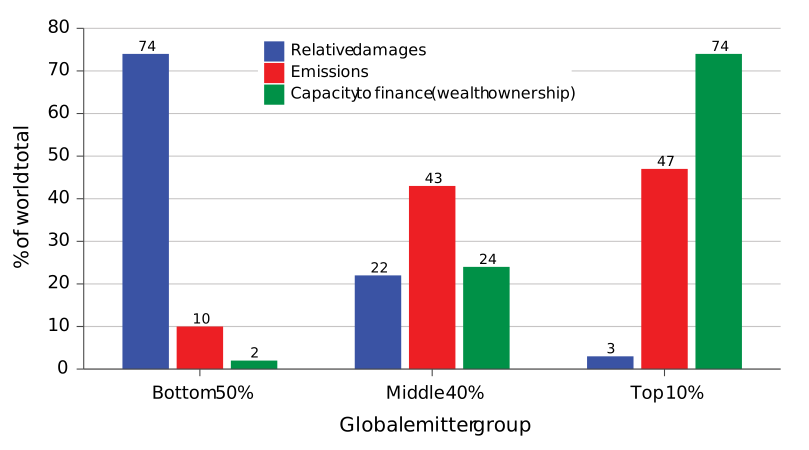
Figure 10 Global carbon inequality: damages vs emissions vs capacity to finance.
Figure I.1 in Chancel, Mohren, Bothe, Muti, and Villaverde. 2025. Climate Inequality Report 2025.
- poverty
- Lacking the basic income needed to maintain a decent standard of living.
Why are climate damages distributed this way? We can explain this finding with the concepts of damages, vulnerability, risk, and hazard. While the hazard (climate change) is the same for everyone, vulnerability varies because differences in physical structures, social conditions, and economic resources influence the specific risks faced by each country and social group, and therefore the eventual damages suffered by them. The unequal distribution of climate damages is due to systemic vulnerability caused by poverty, a lack of basic services and infrastructure, the absence of robust institutions and governance, and limited finance.
One reason for varying damages is the relative importance of outdoor economic activities in low-, middle-, and high-income countries, especially agriculture. Agriculture has a much higher contribution to economic activity in low-income countries, but higher temperatures will reduce both the population’s ability to work outdoors and agricultural productivity.1 2 Thus, while the hazard (the potential threat) is the same, the vulnerability (exposure to the threat) and thus the risk (probability of suffering harm if the threat occurs) is not. Another reason low-income countries are poised to lose more is their limited existing infrastructure, such as air-conditioning, for coping with climate change. Higher temperatures in locations without air-conditioning are associated with efficiency losses in factories,3 reduced academic performance in schools,4 and higher mortality rates overall.5 Here again, the hazard is the same, but the vulnerability and the risk is not. These reasons explain why a 1°C increase in average global temperatures is associated with a 1.4% decrease in income, but only in low-income countries.6
The heightened damages accruing to the most vulnerable countries has led to the creation of the Climate Vulnerable Forum, which brings together 74 highly vulnerable countries to deal with the climate emergency. This group promotes ‘development-positive climate action’, while highlighting the stark realities of climate injustice, which are summarized in Figure 11.
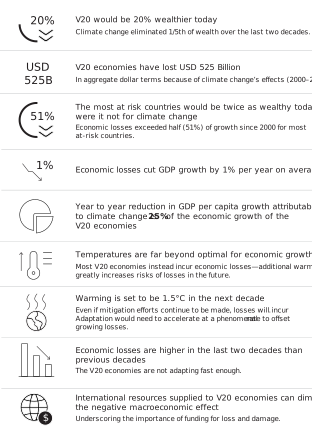
Figure 11 Challenges related to climate change, faced by the most vulnerable countries. The V20 originally represented 20 of the world’s most vulnerable countries, but the group now includes the 74 most vulnerable countries.
Vulnerable Twenty Group. 2022. Climate Vulnerable Economies Loss Report, p. 8.
Exercise 3 Climate change challenges for vulnerable countries
Choose one country from the Climate Vulnerable Forum (the webpage has a map that shows all the member countries). Identify, using online research, two or three specific risks faced by this country due to climate change, and the expected economic impacts of these risks.
Question 4 Choose the correct answer(s)
Among the following options, select the two parties that are typically the most vulnerable to climate-related damages.
- Countries in the Global South are particularly vulnerable to climate-related damages due to low adaptive capacity (relatively low GDP).
- Although coastal cities may be more affected by some aspects of climate change than inland cities (such as sea level rise or tropical storms), they are typically less vulnerable than cities in low- and middle-income countries due to better infrastructure and adaptive capacity.
- Major oil-exporting countries tend to have high GDP so have the economic resources needed to mitigate climate-related damages.
- Small island nations are particularly vulnerable to climate-related damages due to low adaptive capacity (relatively low GDP).
Question 5 Choose the correct answer(s)
The unequal climate change damages between countries are mainly due to which of the following causes?
- Rainfall may vary by country, but the damage that rainfall-related natural disasters can inflict on countries depends on the infrastructure available.
- Differences in national accounting methods may cause slight differences in GDP estimates, but these are not enough to account for the large cross-country variation in climate change damages.
- Differences in physical structures, social conditions, and economic resources influence the specific risks faced by each country and social group, and therefore the eventual damages suffered by them.
- Countries can mitigate climate change damages with adaptation measures. These measures require economic resources, which vary widely by country.
Question 6 Choose the correct answer(s)
Read the following statements about the global distribution of climate change damages and choose the correct option(s).
- Wealthier countries tend to have less exposure to climate change impacts and less vulnerability due to better infrastructure and adaptive capacity.
- This statement is shown in Figure 10.
- This statement is shown in Figure 10.
- While this statement may be true for some wealthy countries, climate damages are a major concern for many other countries (such as those in the Global South).
-
Joshua Graff Zivin, and Matthew Neidell. 2014. ‘Temperature and the Allocation of Time: Implications for Climate Change’. Journal of Labor Economics 32(1): pp. 1–26. ↩
-
Abdikarim Abdullahi Farah, Mohamud Ahmed Mohamed, Osman Sayid Hassan Musse, and Bile Abdisalan Nor. 2025. ‘The Multifaceted Impact of Climate Change on Agricultural Productivity: A Systematic Literature Review of SCOPUS-Indexed Studies (2015–2024)’. Discover Sustainability 6, article no. 397. ↩
-
Achyuta Adhvaryu, Namrata Kala, and Anant Nyshadham. 2018. ‘The Light and the Heat: Productivity Co-benefits of Energy-Saving Technology’. National Bureau of Economic Research Working Paper no. 24314. ↩
-
Joshua Goodman, Michael Hurwitz, Jisung Park, and Jonathan Smith. 2018. ‘Heat and Learning’. National Bureau of Economic Research Working Paper no. 24639. ↩
-
Olivier Deschênes, and Michael Greenstone. 2011. ‘Climate Change, Mortality, and Adaptation: Evidence From Annual Fluctuations in Weather in the US’. American Economic Journal: Applied Economics 3(4): pp. 152–185. ↩
-
Melissa Dell, Benjamin F. Jones, and Benjamin A. Olken. 2014. ‘What Do We Learn From the Weather? The New Climate–Economy Literature’. Journal of Economic Literature 52(3): pp. 740–798. ↩
-
William Nordhaus. 2018. ‘Projections and Uncertainties About Climate Change in an Era of Minimal Climate Policies’. American Economic Journal: Economic Policy 10(3): pp. 333–360. ↩
-
Nicholas Stern. 2006. The Economics of Climate Change: The Stern Review. Cambridge University Press. ↩
-
Editorial note. 2015. ‘Correction to Richard S. Tol’s “The Economic Effects of Climate Change”’. 2015. Journal of Economic Perspectives 29(1): pp. 217–220. ↩
-
Frank Ackerman, Elizabeth A. Stanton, and Ramon Bueno. 2010. ‘Fat Tails, Exponents, Extreme Uncertainty: Simulating Catastrophe in DICE’. Ecological Economics 69(8): pp. 1657–1665. ↩
-
Simon Dietz, and Nicholas Stern. 2015. ‘Endogenous Growth, Convexity of Damage and Climate Risk: How Nordhaus’ Framework Supports Deep Cuts in Carbon Emissions’. The Economic Journal 125(583): pp. 574–620. ↩
