
Climate justice: The intersection of economics, the environment, and inequality
4 Responding to inequalities in emissions, impacts, and damages
- mitigation policies
- Efforts to reduce or prevent the emission of greenhouse gases.
- adaptation policies
- Adjustments in ecological, social, or economic systems in response to actual or expected climate changes and their effects, aimed at moderating harm or exploiting beneficial opportunities.
- intragenerational equity
- The principle of equity in the distribution of resources and opportunities within the same generation, typically across income or social groups.
- intergenerational equity
- The principle of equity in the distribution of resources and opportunities between current and future generations.
Addressing climate change requires both mitigation policies to reduce emissions and adaptation policies to help society adjust to actual or expected disruptions. Using the principles of climate justice, policymakers should consider two dimensions of equity: intragenerational and intergenerational.1
Socioecological stability is the capacity of an interconnected social–ecological system to maintain its core functions, structures, and relationships over time while absorbing disturbances, adapting to change, and avoiding shifts into degraded or unjust states.
Intragenerational equity refers to how the burdens and benefits of current climate policies are allocated across different countries and social groups, while intergenerational equity highlights the moral responsibility to ensure that future generations inherit a liveable planet with sufficient resources and socioecological stability. In both cases, a key concern is to ensure that decision-making processes are inclusive, thus helping to shift power dynamics such that the most vulnerable populations are not only ‘recipients’ of exogenous processes. This is particularly difficult for intergenerational equity given the power asymmetries between adults, youth, children, and future unborn generations.
Mitigation
This section refers to externalities and game theory concepts. If you are unfamiliar with these concepts, please read Sections 4.2–4.4 and Sections 10.1–10.2 of The Economy 2.0: Microeconomics.
- Pareto efficient, Pareto efficiency
- An allocation is Pareto efficient if there is no feasible alternative allocation in which at least one person would be better off, and nobody worse off.
- external cost, negative externality, external diseconomy
- A negative external effect: that is, a negative effect of an economic decision on other people, which is not taken into account by the decision-maker. It may be described as an external cost, or a negative externality, or an external diseconomy. See also: external effect.
- marginal social cost, MSC
- The marginal social cost (MSC) is the cost of producing an additional unit of output, including both the cost for the producer (marginal private cost) and the costs imposed on others (the MEC). MSC = MPC + MEC.
- social cost of carbon (SCC)
- An estimate of the economic damages associated with a one-ton increase in carbon dioxide emissions in a given year.
To learn more about negative externalities and why they result in Pareto-inefficient outcomes, read Section 10.2 of The Economy 2.0: Microeconomics.
To reduce emissions, we need to understand the economic incentives shaping emission decisions. From an economic perspective, excessive emissions (relative to the Pareto-efficient amount) occur because emitters do not bear the full costs of their actions as these are spread across society and future generations. This phenomenon is called a negative externality.
SCC is a specific example of marginal social cost.
The full cost of emissions is measured by the social cost of carbon (SCC). The SCC is an estimate of the economic damages caused by emitting one additional ton of CO2 and is ‘the most important single economic concept in the economics of climate change’.2 The SCC was assessed at approximately USD51 per ton by the US government in 2021,3 though some studies suggest values as high as USD185 per ton, depending on the assumptions used.4 However, current climate negotiations use a value of USD5–10 per ton of CO2 when determining the payment of compensation by high-income countries, corresponding to 10–20% of the SCC established by the US government in 2021.
If the price of oil matched the SCC of USD51 per ton, the price of each barrel of oil would increase by roughly USD22, more than 25% of the average price in 2024. In principle, such an increase (through policies such as taxation) would reduce emissions towards the Pareto-efficient level. Follow the steps in Figure 12 to understand how this principle works.
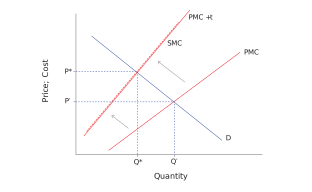
Figure 12 A market with negative externalities.
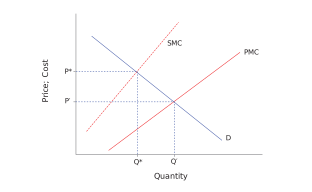
Social and private marginal costs of production
The effect of a tax
To learn more about the polluter pays principle, read Section 20.10 of The Economy 1.0.
- carbon pricing
- An approach to reducing global warming emissions by charging those who emit carbon dioxide for their emissions; this includes carbon taxes and cap-and-trade systems.
- polluter pays principle
- A guide to environmental policy according to which those who impose negative environmental effects on others should be made to pay for the damages they impose, through taxation or other means.
- Pigouvian tax
- A tax levied on activities that generate negative external effects so as to correct an inefficient market outcome. See also: external effect, Pigouvian subsidy.
- prisoners’ dilemma
- A prisoners’ dilemma is a game that has a dominant strategy equilibrium, but also has an alternative outcome that gives a higher pay-off to all players. So in this game, the Nash equilibrium is not Pareto efficient.
- public good
- A good that, if available to anyone, can be made available to everyone at no additional cost. This characteristic is called non-rivalry. Some economists define public goods more strictly as goods that are both non-rival and non-excludable (non-excludable means that it is impossible to prevent anyone from consuming them).
As shown in Figure 12, the idea behind carbon pricing mechanisms is to align individual incentives with societal well-being by shifting the private marginal cost curve to reflect the social marginal cost. This is done by making polluters pay for their carbon output (the polluter pays principle), thereby leading private decision-makers to choose Pareto-efficient levels of emissions.
Carbon taxes are explained in Section 10.4 of The Economy 2.0: Microeconomics. Cap-and-trade systems are explained in Section 20.5 of The Economy 1.0.
The two main carbon pricing mechanisms are carbon taxes and cap-and-trade systems. A carbon tax, a form of Pigouvian tax, is a price-based mechanism that sets a fixed price per ton of CO2 emitted, providing certainty about costs but leaving the quantity of emissions uncertain. In contrast, cap-and-trade systems are quantity-based mechanisms that set an overall emissions limit and allow emitters to trade allowances, ensuring a specific quantity of emissions while letting the market determine the price of carbon emissions.
Carbon pricing mechanisms have the potential to provide a ‘double dividend’ by simultaneously correcting market inefficiencies and providing public resources. Such resources can be used to offset taxation in other areas of the economy (such as income taxes) or fund additional public programmes, particularly those related to clean technology development and adaptation efforts. Moreover, this ‘cross subsidy’ between mitigation taxes and adaptation funding are crucial to deal with the degree to which human-made climate change has already begun and the need for climate justice.
Given the emissions vulnerability paradox (the inverse relationship between emissions and vulnerability to climate change), establishing carbon pricing mechanisms has two challenges:
-
Objections by low-emitting/low-income parties: These parties (for example, India and China) question the mechanisms, arguing they have the right to pollute given the historical emissions of high-emitting/high-income parties, and place the responsibility to act on those longer-term high emitters (for example, the UK and the US). They object to the additional costs that these mechanisms impose on emitting activities, and the reductions in real income and inflationary effects that they imply. There is a need to design offsets for low-emitting/low-income parties that neutralize the negative supply shock of carbon pricing by using the resources collected mostly from high-emitting/high-income parties. From the perspective of low-income countries, incurring higher costs to avoid the high-emission paths of high-income countries is, at best, insensitive to the pressing problems of poverty, and at worst a modern form of ‘kicking-away-the-ladder’5 (preventing low-income countries from using the same methods that high-income countries used to achieve economic growth).
-
Resistance by high-emitting/high-income parties: These parties resist the mechanisms because they would bear most of the added costs but are the ones least burdened by climate change.6 This is especially problematic because these parties also hold the most leverage over design and implementation of climate action, given their economic and geopolitical influence. This challenge only increases with the design of carbon offsets for low-emitting/low-income parties that could become economic or political competitors.
To learn more about how to model the global climate change problem, read Section 4.14 of The Economy 2.0: Microeconomics.
To learn more about public goods and the problem of ‘free riding’ on others’ actions, read Sections 10.6–10.7 of The Economy 2.0: Microeconomics.
This second issue highlights the need to understand the strategic interactions surrounding climate action and negotiations. In fact, strategic interactions within and between countries are reasons why addressing climate change has proven particularly difficult. Countries face a prisoners’ dilemma scenario: they are collectively better off by reducing their emissions, but each country has an incentive to keep polluting as it gains in the short term while others pay the cost. Also, since climate stability is a global public good, each country would prefer others to act while continuing to emit, reaping the benefits while not incurring the costs.
To learn about how altruism and social norms can help achieve cooperative outcomes, read Section 4.10 of The Economy 2.0: Microeconomics.
- altruism
- Altruism is a social preference: a person who is willing to bear a cost to benefit somebody else is said to be altruistic.
- social norm
- An understanding that is common to most members of a society about what people should do in a given situation when their actions affect others.
- tragedy of the commons
- A social dilemma in which self-interested individuals acting independently deplete a common resource, lowering the payoffs of all. See also: social dilemma.
- Nash equilibrium
- A Nash equilibrium is an economic outcome where none of the individuals involved can bring about an outcome they prefer by unilaterally changing their own action. More formally, in game theory it is defined as a set of strategies, one for each player in the game, such that each player’s strategy is a best response to the strategies chosen by everyone else. See also: game theory.
This situation is only worsened by the two challenges described above, and by the fact that the stark differences in income, power, and realities between countries make cooperative mechanisms such as altruism and social norms weaker. The result is a Pareto-inefficient tragedy of the commons where insufficient climate action is taken, even though cooperation would leave everyone better off.
The prisoners’ dilemma faced by countries dealing with climate change can be modelled as the two-player game shown in Figure 13. The strategy (Pollute, Pollute) is a Nash equilibrium because each player is achieving the highest possible pay-off given what the other player is doing. In this prisoners’ dilemma, Pollute is a dominant strategy because it gives a player higher pay-offs than Abate, regardless of what the other player does. For this reason, (Abate, Abate) cannot be a Nash equilibrium because each player can improve their pay-off by changing their strategy.
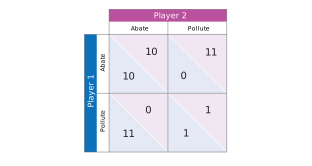
Figure 13 Climate change as a prisoners’ dilemma game.
The Paris Agreement is an international treaty adopted in 2015 under the United Nations Framework Convention on Climate Change that is aimed at limiting global warming to well below 2°C above pre-industrial levels.
This game helps illustrate how negotiations under the United Nations Framework Convention on Climate Change are crucial to achieving the cooperation needed for collectively positive outcomes. Since individual countries have incentives to benefit from others’ mitigation efforts without contributing themselves, and these perverse incentives are only amplified by the emissions vulnerability paradox, binding agreements to abate can help align incentives. Agreements such as the Paris Agreement (discussed in Section 5) create frameworks for collective action by setting national emissions reduction targets and encouraging transparency. Additionally, side payments (compensation to support commitments) and trade incentives can help countries commit to mitigation efforts. Although international agreements to fight climate change have had limited success, they are the most promising way to implement policies to resolve global externalities, create global markets where they are missing, shift incentives at such a scale, and transform a global prisoners’ dilemma into a cooperative solution.
Exercise 4 Addressing the prisoners’ dilemma
Redraw the prisoners’ dilemma game in Figure 13 to illustrate how the following policies might change the pay-offs from each action and result in (Abate, Abate) becoming a Nash equilibrium:
- carbon taxation
- climate change negotiations
- an increase in adaptation funding
- side payments from one player to another.
Adaptation
Adaptation is a key arena of climate action and climate justice given that the climate has already changed and will continue to do so with increasingly adverse effects until serious mitigation efforts are made. This reality requires adjusting to new conditions to minimize vulnerabilities, losses, and damages.
The Glasgow Climate Pact included an agreement on climate finance: high-income countries aimed to meet their targets of providing USD100 billion annually to low-income countries and to double the financial support for adaptation measures and climate resilience in these countries.
Financing climate adaptation is a particularly relevant dimension for climate justice, as the emissions vulnerability paradox calls for the high-income (least vulnerable) countries to help the most vulnerable ones. Based on arguments of responsibility and cause/effect, the high-income countries that created the problem should provide resources to the lower-income countries that did not create the problem but are suffering from it. This was formalized in the 2021 Glasgow Climate Pact.
Despite pledges by high-income countries to provide these resources, there is a glaring adaptation funding gap. In a 2023 report, the Intergovernmental Panel on Climate Change (IPCC) estimated the gap to be USD187–359 billion per year.7 The increases in finance and efforts reported by the United Nations Environment Programme Adaptation Gap Report 20248 indicate that the 2022 increase in international public adaptation finance flows to middle- and low-income countries, from USD22 billion in 2021 to USD28 billion in 2022, reduced the financing gap by 5%. Although it was the largest absolute and relative year-on-year increase since the 2015 Paris Agreement, this remains far from current adaptation financing needs, and even further from future needs that are expected to grow as global warming levels worsen.
Another finding of the 2023 IPCC report was that although adaptation financing was growing, resources were not necessarily flowing to the most vulnerable countries or to the most vulnerable groups within each country. For example, middle-income countries are almost always excluded from key climate finance despite their climate vulnerability. This exclusion is because the UN prioritized low-income countries when it funded the development of National Adaptation Plans and related vulnerability assessments in the 2010s. For this reason, some Central American middle-income countries that rank within the ten most vulnerable countries worldwide do not have the support, capacity, or resources to develop their vulnerability assessments and National Adaptation Plans, leading to decades-long gaps in adaptation action.
The term ‘confidence’ combines evidence and agreement in scientific literature. High confidence means strong evidence with high agreement.
A delay in financing and implementation can lead to missed opportunities as windows of action narrow or close. The effectiveness of many adaptation options is reduced as 2°C of global warming levels are approached and surpassed. Thus, actions need to be implemented before such limits are reached. For example, the IPCC’s Sixth Assessment Report (2023) found, with a high level of confidence, that water-based adaptation options have a significantly reduced effectiveness when approaching 2°C, leading to increased water and food insecurity and the endangerment of livelihoods.
As adaptation effectiveness decreases and global warming levels continue to increase, natural, human, and managed systems start to experience more visible and severe impacts, which can be irreversible. When such a point of no return is reached, the system exhibits what is known as a ‘limit of adaptation’. There are two types of limits to adaptation: soft and hard. Soft limits are those where adaptation options are not currently available but might be in the future, or where options exist but face financial constraints or socio-cultural barriers. Hard limits are those where no level of adaptation intervention can reverse the damage to the system or avoid intolerable risks.9
Figure 14 shows the temperatures at which various natural, human, and managed systems will reach these limits, each bar representing a different system. The white portion of the bars indicate that there are no visible impacts. The yellow portion of the bars indicate that impacts are visible but that adaptation options are sufficient and effective. In the orange portion, impacts are stronger, and while adaptation options are still feasible, their effectiveness starts to decline. The red portion indicates that there are significant impacts with increasing irreversibility, and that adaptation is no longer effective. Purple means very high risks of severe impacts and the presence of significant irreversibility. Three systems with early red portions are:
- coral reefs (warm-water corals), which face irreversible damage (bleaching) at 1°C
- small-scale, low-lying fisheries and the Arctic region, which face irreversible damage at between 1°C and 1.5°C.
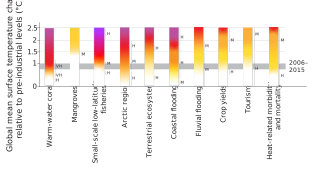
Figure 14 Burning embers. Each bar represents the impacts a particular ecosystem is expected to suffer under different warming levels. Confidence level for transition is noted as L for low, M for medium, H for high and VH for very high.
Figure SPM.2 in IPCC. 2018. ‘Summary for Policymakers’.
The Central American Dry Corridor is a dry forest region spanning five Central American countries. It is vulnerable to heatwaves and droughts.
For many systems and world regions, we lack the evidence to produce a similar ‘burning embers’ graph, but that does not signify a lack of risks. These risks exist and more research needs to be carried out to determine when adaptation options will reduce their effectiveness and when certain systems will face irreversible changes. For example, in Central America, some existing knowledge gaps include limits in the Central American Dry Corridor, which would have a direct impact on food and water security and livelihoods, as well as the limits to hydroelectricity generation, which many Central American countries rely on. This gap in knowledge production in some vulnerable regions and middle-income countries can also be considered as a matter of climate justice as scholars and researchers from these countries face many barriers to publication and information dissemination, including language barriers of having English as a second language, and high costs for publication (or to make articles open access).
In Central and South America, there is low confidence in some of the risks posed by different levels of global warming. Using the IPCC’s definition, ‘low confidence’ means there is not much evidence (few articles or studies) and/or low agreement between them. We do, however, know of some impacts that will worsen and might reach limits if adaptation options are not implemented. Examples include risks to water security, severe health effects due to increasing epidemics (especially vector-borne diseases), coral reef ecosystem degradation due to coral bleaching, risks to food security due to frequent/extreme droughts, and damage to life and infrastructure due to floods, landslides, sea level rise, storm surges, and coastal erosion.
Exercise 5 Ecosystem impacts of climate change
Choose one ecosystem in Figure 14 and use research online to answer the following questions:
- What specific environmental processes and natural resources are involved in this ecosystem?
- Describe the expected impacts on this ecosystem at different levels of global warming (for example, once specific temperature thresholds or ranges are crossed).
- Which countries are likely to be the most affected by these impacts?
- What kinds of adaptation options are available?
Losses and reparations
Hard limits are intrinsically related to the concept of losses. Unlike damages, losses are irreversible, such as the loss of life, biodiversity, and cultural heritage. For example, in low-lying island nations, sea level rise can force people to migrate and in doing so, abandon their livelihoods and cultural heritage sites. If these people cannot relocate together, traditions and languages could also be lost. Section 5 details the role of island nations and other vulnerable countries in shaping the 1.5°C goal to reduce losses and damages.
- technology transfer
- The sharing of climate-relevant technologies, knowledge, and technical expertise—such as renewable energy systems, adaptation tools, or early-warning technologies—by actors with greater technological capacity with those with less, enabling effective mitigation and adaptation.
- capacity building
- The strengthening of skills, institutions, and governance systems of individuals and organizations so they can design, implement, maintain, and govern climate policies and technologies independently over time.
In the face of losses, climate justice calls for reparations in the form of financial compensation, technology transfer, and/or capacity building. Integrating mechanisms for reparations of losses alongside compensation for damages into international climate frameworks have become a crucial matter of fairness and a critical step toward building trust and enabling effective global climate cooperation. Yet, at the same time, the issue has become one of the most controversial in negotiations, with middle- and low-income countries advocating for it and high-income countries resisting, given limited public resources and the conflict of interest in providing resources to potential competitors.
Climate-resilient development
- climate-resilient development (CRD)
- Development that integrates climate adaptation and mitigation efforts with sustainable development to enhance systemic resilience across society and ecosystems.
Climate justice goes beyond dealing with the emissions vulnerability paradox. Apart from accounting for the distribution of emissions and the costs of those emissions, climate justice encompasses the idea of climate-resilient development (CRD), a concept introduced by the IPCC.
The goals of CRD are to effectively integrate mitigation, adaptation, biodiversity conservation, and the achievement of sustainable development. Unlike standard climate action, CRD stresses the importance of societal choices in shaping pathways towards a sustainable future.
To achieve CRD, the quality of interactions among actors is paramount, giving importance to each person, including the most vulnerable and marginalized populations, and therefore requiring periodical discussions in diverse arenas. Participation within arenas of engagement with a focus on the quality of interactions helps address current concerns that there is not any proper engagement with vulnerable groups such as local and Indigenous communities, and that any participation that does happen is merely a formality or a requirement and does not properly address concerns.
A key element of CRD is also the interrelated nature of the actions needed to address climate change, and thereby the need for system transitions to address mitigation through socio-technical transformations, and adaptation through socioecological resilience. For example, forest protection in rural and low-income communities involves the dimensions of energy, livelihoods, and ecosystems, thereby requiring a system transitions approach to recognize the relationships between these dimensions, to identify and address trade-offs, and to reduce maladaptation (actions that increase the risk of worse climate outcomes).
Figure 15 illustrates the multiple pathways that can be taken to achieve CRD.
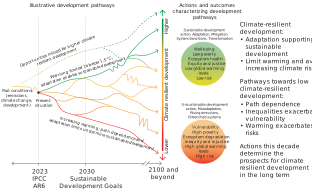
Figure 15 Climate-resilient development and potential pathways.
IPCC. 2023. ‘Summary for Policymakers’.
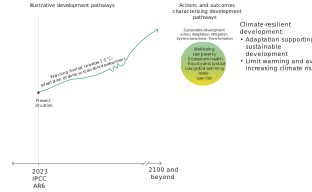
Development that is more climate resilient
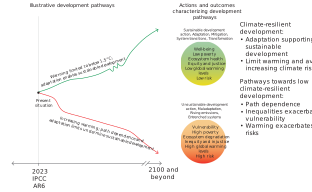
Development that is less climate resilient
The importance of current adaptation and mitigation efforts
The pathways are shaped by a whole society approach in which interactions occur through arenas of engagement. These arenas can be thought of as spaces of deliberation, action, protest, and interaction where actions can be discussed. They can take place in town halls with political candidates, during a debate between academics in a lecture hall, in voting booths, through protests to protect an endangered species or ecosystem, through traditional or local activities with linkages to nature (for example, Indigenous traditions and the role of Indigenous visions and values). Giving quality space, voice, and power to the most vulnerable, or often excluded people, helps bring justice and equity to the process and rebalance power dynamics that have currently increased injustices. The ‘Find out more’ box in this section gives an example of one city’s approach to CRD.
Climate-resilient development is, at its core, about climate justice since inequality and injustice are not only about emissions and impacts but also about participation and power. Research and its dissemination, including through and for Indigenous populations and vulnerable and marginalized people who are not usually allowed a voice, can help expand the science on impacts at a local level and further highlight the urgency for action.
Find out more Climate-resilient development in cities and municipalities: The example of Cape Town
The City of Cape Town, South Africa, created the 2022–2027 Integrated Development Plan enshrined in a vision statement entitled the ‘City of Hope’. The plan outlines priorities, programmes, and initiatives that link climate action to sustainable development, committing to climate-resilient development.
The Integrated Development Plan has three top and three secondary priorities. The top priorities are ‘inclusive economic growth’, focusing on economic growth to reduce poverty; basic services; and safety. Secondary priorities focus on housing; public space, environment and amenities; and transport. These actions are implemented in an integrated way to support climate change and resilience strategies in conjunction with plans to manage disaster risk.
For example, one of the city’s programmes focuses on changing business models for the payment of utilities, recognizing that uncertainties and constraints due to climate impacts require more flexibility, especially to reduce vulnerability in certain population segments. These changes include urban cooling and heat responsiveness; climate change response monitoring, evaluation, learning, and reporting; establishing an evidence base for climate change to support decision-making; and climate change communication and collaboration.
Figure 16 summarizes how the six priorities support the foundations of a resilient city, a more spatially integrated and inclusive city, and a capable and collaborative city government.
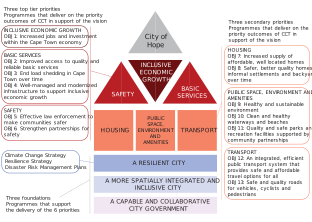
Figure 16 A blueprint of the City of Hope for the City of Cape Town (CCT).
Figure 1 in Nicholas P. Simpson et al. 2023. ‘Climate-Resilient Development Planning for Cities’.
The City of Hope vision statement is one example of how CRD can be led and implemented within local governments, presenting a model for city-to-city and South-to-South cooperation. It shows the transformative nature of the actions that need to be implemented and how they could be implemented.
Question 7 Choose the correct answer(s)
There are multiple pathways to achieving climate-resilient development. Which of the following factors are barriers towards achieving CRD?
- These gaps are a barrier to achieving CRD. We need accurate and up-to-date knowledge about the current climate situation and how our actions can improve or worsen outcomes (to avoid maladaptation). We also need the appropriate technologies to implement climate action.
- These policies help achieve CRD, so are not a barrier.
- A fundamental principle of CRD is ensuring all groups in society participate in the climate discussion, so if certain groups are excluded or do not participate, then we cannot achieve this principle.
- Certifications and standards, such as minimum energy efficiency requirements on buildings or appliances, can help reduce emissions, and in turn, help achieve CRD.
-
Intergovernmental Panel on Climate Change (IPCC). 2023. ‘Summary for Policymakers’. In Climate Change 2022 – Impacts, Adaptation, and Vulnerability: Working Group II Contribution to the Sixth Assessment Report of the Intergovernmental Panel on Climate Change. Cambridge University Press, pp. 3–34. ↩
-
Lint Barrage, and William D. Nordhaus. 2023. ‘Policies, Projections, and the Social Cost of Carbon: Results From the DICE-2023 Model’. National Bureau of Economic Research Working Paper no. 31112, p. 25. ↩
-
Interagency Working Group on Social Cost of Greenhouse Gases. 2021 (February). Technical Support Document: Social Cost of Carbon, Methane, and Nitrous Oxide: Interim Estimates under Executive Order 13990. United States Government. ↩
-
Kevin Rennert et al. 2022. ‘Comprehensive Evidence Implies a Higher Social Cost of CO2’. Nature 610: pp. 687–692. ↩
-
Ha-Joon Chang. 2002. Kicking Away the Ladder: Development Strategy in Historical Perspective. Anthem Press. ↩
-
Glen Althor, James E. M. Watson, and Richard Fuller. 2016. ‘Global Mismatch Between Greenhouse Gas Emissions and the Burden of Climate Change’. Nature Scientific Reports 6, article 20281. ↩
-
Intergovernmental Panel on Climate Change (IPCC). 2023. ‘Summary for Policymakers’. In Climate Change 2022 – Impacts, Adaptation, and Vulnerability: Working Group II Contribution to the Sixth Assessment Report of the Intergovernmental Panel on Climate Change. Cambridge University Press, pp. 3–34. ↩
-
United Nations Environment Programme. 2024. Adaptation Gap Report 2024. Come Hell and High Water: As Fires and Floods Hit the Poor Hardest, it is Time for the World to Step Up Adaptation Actions. Nairobi: United Nations Environment Programme, 2024. ↩
-
Intergovernmental Panel on Climate Change (IPCC). 2014. Climate Change 2014: Synthesis Report. Contribution of Working Groups I, II and III to the Fifth Assessment Report of the Intergovernmental Panel on Climate Change. Core Writing Team: R. K. Pachauri, and L. A. Meyer (eds.). ↩
