
Climate justice: The intersection of economics, the environment, and inequality
5 Failures and successes of climate change negotiations
- Multilateral Environmental Agreements (MEAs)
- Treaties between three or more countries aimed at addressing environmental issues with coordinated international action.
Climate change, as a global externality, requires global action. Historically, this action has been developed under multilateral negotiations based on an international system called the United Nations Framework Convention on Climate Change (UNFCCC). The vision behind this and other multilateral environmental agreements is a political project founded on the principles of consultation, inclusiveness, solidarity, and consensus. Thus, multilateral agreements function through collectively developed rules that facilitate sustainable and effective cooperation. Multilateralism is therefore both a method of cooperation and a form of organizing the international system. In principle, these rules should guarantee that all those involved have the same rights and obligations.
Given the failure to reduce emissions, there are growing criticisms about the ineffective nature of multilateral negotiations based on the international system, especially around the UNFCCC.1 In response, plausible alternatives have emerged favouring more decentralized arrangements2 and more populated and powerful nation states such as those regrouped under the G20.3 This has occurred as the world witnesses a gradual weakening of multilateralism, at least partly due to resurgence of nationalist and populist governments that have highlighted the stark reality of power differences and increasing geopolitical polarization. In this section, we start by examining the successes and failures of the negotiation process under the UNFCCC.
The United Nations Framework Convention on Climate Change
Multilateral environmental conventions are part of international environmental law because they are international agreements or treaties approved by a broad community of nations to define the rights and obligations of nation states in environmental matters. They arose after the 1972 Stockholm Conference and the creation of the United Nations Environment Programme. Between 1972 and 2012, more than 250 legal instruments of international environmental law were created, which made it possible to build an international, inter-jurisdictional environmental regime that is still in operation today.
The UNFCCC is one of three multilateral environmental agreements signed during the Earth Summit in Rio de Janeiro, Brazil, in June 1992. The stated objective of this Framework Convention is to ‘prevent dangerous anthropogenic interference with the climate system’ by stabilizing greenhouse gas concentrations in the atmosphere, essentially aiming to prevent dangerous human-caused climate change. To achieve this goal, the UNFCCC defined a few key concepts and proposed a robust governance system to reach agreements on implementing affirmative actions at the national and global scale that address and avert climate change.
A critical guiding concept in the multilateral climate change negotiations is that of ‘common but differentiated responsibilities and respective capacities’, according to Article 3.1 of the UNFCCC, which stipulates that ‘the Parties should protect the climate system for the benefit of present and future generations of humankind, on the basis of equity and in accordance with their common but differentiated responsibilities and respective capabilities. Accordingly, developed country Parties should take the lead in combating climate change and its adverse effects’.4
By this principle, and tacitly recognizing the emissions vulnerability paradox, the UNFCCC places greater responsibilities on industrialized countries, as they have historically generated most of the greenhouse gas emissions in the past and have greater capacity to respond to climate change impacts. These parties are referred to as ‘Annex I countries’ because they are listed in the first annex of the treaty. Middle- and low-income nations are referred to as ‘non-Annex I countries’. Most of these countries are part of the G77 + China negotiation bloc of developing countries at the United Nations. Article 3.2 stipulates considerations for this bloc in terms of lower responsibilities for reducing emissions. However, many emerging economies, such as Brazil, China, and India, have reached total and per capita emissions levels that also require urgent mitigation measures, without ignoring the historical responsibilities for emissions of Europe and the United States.
These differentiated responsibilities required a careful assessment of development needs and specific conditions of emerging countries. According to Article 3.4 of the UNFCCC, ‘the Parties have a right to, and should, promote sustainable development’ according to ‘the specific conditions of each Party’. The convention takes special consideration of the need for low- and middle-income countries to grow economically and therefore accepts that their share of greenhouse gas emissions will grow in the coming years. This can be construed as a right to pollute in the name of ‘development’. However, enabling these countries to limit emissions without harming their economic progress requires high-income countries to contribute financing, capacity building, and technology transfer for sustainable development. This has proven to be difficult, especially in the context of research publications pointing out that the world is not on track to prevent dangerous climate change,5 and in the face of growing geopolitical tensions.
Kyoto Protocol and REDD+ initiatives
In the 1990s, there was a surge of market-driven initiatives under the UNFCCC, which also reflected the times, as many industrial countries were run by neoliberal-minded governments. This trend led to the signing of the 1997 Kyoto Protocol, which did not come into force until 2005. At the 2007 COP13 in Bali, Indonesia, there was a drive to agree on a ‘Bali Action Plan’ which sought to accelerate the implementation of both the UNFCCC and the Kyoto Protocol.
One of the key instruments proposed by the Kyoto Protocol was the Clean Development Mechanism, by which polluting countries or businesses with a large carbon footprint could compensate for their emissions through an emissions trading system or carbon market. Two years later (2009) at COP15 in Copenhagen, Denmark, the negotiations reached a dead end, as tensions between middle-/low-income countries and high-income countries came to a head. After the failure of COP15, Mexico hosted COP16 in Cancun and helped forge important agreements including the norms and regulations concerning the Reduction of Emissions from Deforestation and Degradation (REDD), which later became known as the REDD+. The ‘+’ stands for additional forest-related activities that protect the climate. Cancun is also remembered as the COP that sealed the agreement for the creation of the Green Climate Fund in 2010, a fund established within the UNFCCC framework to assist developing countries in adaptation and mitigation practices to counter climate change.
Several Latin American countries, notably Brazil and Honduras, were among those that benefitted most from Clean Development Mechanism funding under the Kyoto Protocol. Latin American countries have historically supported the implementation of REDD+ because it offers results-based payments for reducing deforestation, and these countries still possess large areas of forests that qualify as carbon sinks (systems that absorb more CO2 from the atmosphere than they release) under both Clean Development Mechanism and REDD+ initiatives. The experience gained by these initiatives served to inform many of the following stages of the negotiations, including the Durban Plan for Enhanced Action which paved the way for reaching the 2015 Paris Agreement at COP21.
The timeline in Figure 17 summarizes the key milestones in climate negotiations since 1992.
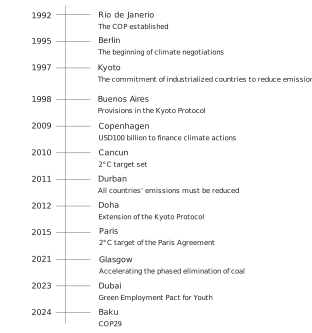
Figure 17 Important milestones in global climate negotiations.
The Paris Agreement
The run-up to the Paris Agreement in 2015 helped build consensus and overcome many of the obstacles that had led to the dead end at COP15 in 2009, such as the sharp North–South division, disagreement over the legally binding nature of agreements, the top-down setting, and climate finance. The agreement was also bolstered by several important scientific milestones such as the IPCC’s Fifth Assessment Report in 2014, which was the result of a series of COP decisions taken prior to Paris. For instance, in terms of diversity, equity, and inclusion, the creation of the Lima Work Programme on Gender at COP20 in 2014 built on the momentum of the COP19 in Warsaw in 2013. At COP19, another important decision was taken: the creation of the Warsaw International Mechanism (WIM) on loss and damage. The WIM is the work programme under the UNFCCC to address, minimize, and avert the impacts of unavoidable loss and damage attributable to climate change. The WIM’s work programme also paved the way for the drafting of Article 8 of the Paris Agreement in 2015 on loss and damage.
The importance of the Paris Agreement cannot be overstated, as it constitutes a legally binding agreement under international law, although pertaining to procedures and not to targets. It also represents a watershed moment in the negotiations under the UNFCCC, whereby many of the polarized discussions surrounding common but differentiated responsibilities were overcome and an enhanced transparency mechanism was formed to operate under the convention. Another major difference from previous legal instruments like the Kyoto Protocol is that the Paris Agreement was ratified by most parties to the convention and entered into force in October 2016, less than a year after it was adopted. Parties were required in 2015 to present their nationally determined contribution (NDC), and a five-year cycle of ambition led to updated NDCs in 2020 and 2025. Another important scientific milestone was the 2018 IPCC ‘Special Report on Impacts of Global Warming at 1.5°C’, which signalled the potential for early loss and damage due to climate change.6
Many of the negotiations since 2015 have centred on the Paris Agreement’s rulebook; in the case of Article 6 on carbon markets, it took over six years to achieve an outcome acceptable to all parties. Among the issues still to be resolved, those that most stand out are related to climate finance to address many of the challenges faced by low- and middle-income countries to implement their NDCs, adapt, and obtain reparations (in accordance with Article 8 on loss and damage). At the time this Insight was published, the last three COPs (COP27 in Sharm-El-Sheik, COP28 in Dubai, and COP29 in Baku) were dominated by the issue of climate finance, but with little progress (discussed further in the ‘Find out more’ box).
Find out more The role of small and vulnerable countries in achieving climate justice
The Climate Vulnerable Forum (CVF) is a bloc of small and vulnerable countries in the climate negotiations arena. Created in 2009 at COP15 in Copenhagen, the CVF brings together a total of 74 countries (Figure 18), representing over 1.7 billion people and 5% of global GDP. It has been an increasingly important voice for exploring options to address climate justice issues from a constructive and informed perspective. The forum has also signalled clearly that the climate crisis builds and compounds risks from other global crises such as the debt crisis faced by many low- and middle-income countries. The forum proposes pragmatic and achievable steps to reduce the social, economic, and financial vulnerability of member countries to the impacts of climate change.
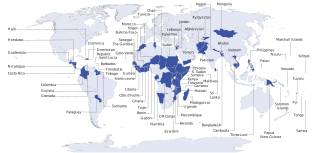
Figure 18 Member countries of the Climate Vulnerable Forum.
Another important bloc of small and vulnerable countries is the Alliance of Small Island States. This bloc, alongside the African Union and other low- and middle-income countries, highlighted at the COP21 in Paris that 2°C was a dangerous limit for them. At this level of warming, some coastal areas would be lost due to sea level rise, forcing the displacement of millions of people with the associated loss of culture, heritage, language, and livelihoods. The pressure of these countries helped the Paris Agreement to state a target of ‘Holding the increase in the global average temperature to well below 2°C above pre-industrial levels and pursuing efforts to limit the temperature increase to 1.5°C above pre-industrial levels’.7
Developed countries agreed to a 1.5°C goal while maintaining the 2°C goal in the text. As part of the Paris Agreement, member states requested the IPCC to assess whether prior emissions had already committed the world to reaching 1.5°C, whether limiting temperature increase to 1.5°C was still feasible, and if so, how to achieve this. This report highlighted the need to work systemically, both across system transitions and between mitigation and adaptation. Later, in the IPCC’s Sixth Assessment cycle, this push continued to evolve into the concept of CRD presented in Section 4. Despite the closing window of opportunity to limit heating to 1.5°C, this goal advanced by small and vulnerable countries created a systemic change in the way climate action is viewed, linked to sustainable development and underpinned by equity, ethics, justice, and inclusion.
Question 8 Choose the correct answer(s)
Read the following reasons for why international climate agreements have struggled to achieve their goals, and choose the correct option(s).
- There is widespread awareness of climate change, which is why countries meet annually at the COP to discuss this issue.
- The countries least responsible for climate change (and most affected by climate change) are also the ones with the least power in climate negotiations, so they have little authority to force large greenhouse gas emitters to take climate action.
- Countries that have adaptive capacity may be unwilling to contribute to climate finance because they would be funding other countries that can or may compete with them in the future.
- While we may lack scientific data to quantify some impacts of climate change, this reason does not explain why climate agreements have not achieved their goals, since prudent actions can still be taken to avoid passing the ‘hard limits’ discussed in Section 4.
Exercise 6 Tracking climate action
The Climate Action Tracker website measures how close countries are to meeting their commitment in the Paris Agreement (limiting temperature increases to 1.5C above pre-industrial levels).
For the country you live in (or a country of your choice):
- What is the overall rating for this country given by the Climate Action Tracker?
- Select the country from the list to read a summary of its climate actions. Based on this information, outline some reasons for the country’s overall rating.
- What policies does this country implement to address climate change? Categorize these policies into ‘adaptation’ or ‘mitigation’.
- Identify some gaps in this country’s climate action, and suggest appropriate policies or measures to address them.
-
David G. Victor. 2011. Global Warming Gridlock: Creating More Effective Strategies for Protecting the Planet. Cambridge University Press. ↩
-
Robert O. Keohane, and David G. Victor. 2016. ‘Cooperation and Discord in Global Climate Policy’. Nature Climate Change 6(6): pp. 570–575. ↩
-
Kanica Rakhra. 2023. ‘The G20 as a Multilateral Force’. CEBRI-Journal Year 2(8): pp. 77–94. ↩
-
United Nations. 1992. United Nations Framework Convention on Climate Change, p. 4. ↩
-
Intergovernmental Panel on Climate Change (IPCC). 2023. ‘Summary for Policymakers’. In Climate Change 2022 – Impacts, Adaptation, and Vulnerability: Working Group II Contribution to the Sixth Assessment Report of the Intergovernmental Panel on Climate Change. Cambridge University Press, pp. 3–34. ↩
-
Intergovernmental Panel on Climate Change (IPCC). 2018. ‘Summary for Policymakers’. In Global Warming of 1.5°C: IPCC Special Report on Impacts of Global Warming of 1.5°C above Pre-industrial Levels in Context of Strengthening Response to Climate Change, Sustainable Development, and Efforts to Eradicate Poverty. Cambridge University Press, pp. 3–24. ↩
-
United Nations Framework Convention on Climate Change. 2016. Report of the Conference of the Parties on its Twenty-First Session, held in Paris from 30 November to 13 December 2015, p. 2. ↩
