
Vulnerability to poverty: Public, private, and community responses
2 The dynamics of vulnerability and poverty traps
We are all exposed to fluctuations in our income, sometimes for reasons beyond our control and sometimes because our decisions have unexpected consequences. ‘Shocks’ are larger-than-usual fluctuations (positive or negative) that are beyond our control, for example a severe economic downturn, a sudden shift towards free elections, a new cash transfer programme for the poor, a tax exemption for the rich, or unexpected climate conditions that favour agriculture in one region. However, we are unequal in the face of these shocks: the multiple forms of social inequality mean that when shocks occur, their effect on each household depends on how fragile its sources of income are. Some households can overcome negative shocks with their savings, assets, and alternative sources of income, while others cannot and are pushed into poverty (this situation is also known as ‘shock-induced poverty’).
Therefore, poverty is not a static condition, but rather a dynamic process that is influenced by various factors, including shocks, stresses, and coping mechanisms. Households may fall into a ‘poverty trap’ and find it very difficult to move upward after experiencing a shock.
Modelling poverty traps
Read Section 8.3 of The Economy 2.0: Macroeconomics to learn more about tipping points and poverty traps.
To model poverty traps, we will use the tipping point model from Unit 8 of The Economy 2.0: Macroeconomics.
- human capital
- The stock of knowledge, skills, behavioural attributes, and personal characteristics that determine the labour productivity or labour earnings of an individual. Investment in human capital, through education, training, and socialization, can increase the stock. Human capital is part of an individual’s endowment. See also: endowment.
- intergenerational inequality
- The extent to which differences in parental generations are passed on to the next generation, as measured by the intergenerational elasticity or the intergenerational correlation. See also: intergenerational elasticity, intergenerational mobility, intergenerational transmission of economic differences.
Imagine a household with two generations whose income depends on their human capital (HK), which includes their skills, health, and other characteristics that determine how much income they can earn. Acquiring human capital requires luck, effort, and investment in education, as well as food, shelter, and other essentials. Higher levels of skills, health, and particular characteristics (such as social networks) generate higher earnings on average. Some of these skills, health, and characteristics are transmitted from parents to their children, either genetically or through household practices and the transfer of financial assets. That is why most societies show a certain degree of correlation between parents’ outcomes and their children’s (known as intergenerational inequality). Latin America, for instance, shows one of the highest correlations between the education or income of an individual and those of their mother.1
To show this dependence, Figure 1 graphs the parent’s level of human capital on the horizontal axis and their children’s level of human capital on the vertical axis. In this tipping point model, the S-shaped function (the ‘human capital dynamics curve’) represents the relationship between a parent’s human capital (period \(t\)) and their children’s human capital in the next period (\(t+1\)). The 45-degree line shows all points where the parent’s and children’s level of human capital are the same (zero mobility). When the human capital dynamics curve is above the 45-degree line, it means that the next generation experiences an improvement in their human capital (upward mobility), and when it is below the 45-degree line, the next generation experiences downward social mobility.
To learn more about the difference between stable and unstable equilibria, read Section 8.2 of The Economy 2.0: Macroeconomics.
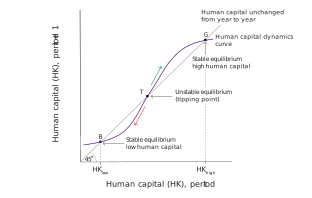
Figure 1 The human capital dynamics curve.
- stable equilibrium
- An equilibrium is stable if a small movement away from the equilibrium is self-correcting (leading to movement back toward the equilibrium). See also: equilibrium.
- unstable equilibrium
- An equilibrium is unstable if, when a shock disturbs the equilibrium, there is a subsequent tendency to move even further away from the equilibrium. See also: equilibrium.
- tipping point
- A tipping point is an unstable equilibrium at the boundary between two regions. A small movement into either of the regions causes a movement further into the same region, away from the equilibrium. See also: asset price bubble.
The points where the human capital dynamics curve intersect the 45-degree line are equilibria, because human capital remains unchanged across generations. There are two stable equilibria: a poverty trap (point B) characterized by low human capital in every generation (\(\text{HK}_\text{low}\)) and a high human capital equilibrium (point G) for households that have escaped the poverty trap (\(\text{HK}_\text{high}\)). In between, there is an unstable equilibrium where a tipping point (T) exists, from which it is easy to move in either direction: households with human capital slightly below T will end up in the poverty trap, while households with human capital slightly above T will escape the poverty trap.
Figure 2 uses a ‘ball on a hill’ analogy to show the differences between stable and unstable equilibria. The top of the hill is an equilibrium, as the ball could remain balanced there indefinitely as long as it’s not disturbed. However, this equilibrium is unstable (a tipping point), as any slight shift to the left or right will cause the ball to roll off the top, and this change is hard to reverse. The valleys on either side of the hill represent stable equilibria.
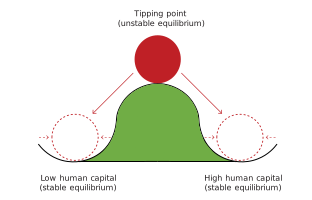
Figure 2 Unstable equilibria, stable equilibria, and tipping points.
In Figure 1, point B is a self-perpetuating situation because parents with low human capital have urgent priorities such as housing or food, leaving them with limited income to invest in their children’s education. Also, in countries with inadequate public education systems, children are unlikely to acquire enough human capital through government-provided schooling to move past the tipping point (T), so they end up with the same low human capital as their parents.
Using the same logic, point G is self-perpetuating because parents with high human capital have enough income to send their children to private schools if the public education system is inadequate. Through private schools, their children will also gain cultural capital (connections and networks) that will help them obtain employment and partnerships in the future. Investment in these private solutions also makes households with high human capital less willing to contribute (through taxes, civic engagement, or political participation) to improvements in the public system that could lift those in the poverty trap past the tipping point.
This dynamic, nonlinear system creates a segregated society with a large fraction of the population with low levels of human capital for parents and children trapped at point B, and a small fraction of households at point G with high levels of human capital. The low income and education mobility observed in many middle- and low-income countries is consistent with this poverty trap model.
Modelling vulnerability to poverty
The concept of ‘vulnerability to poverty’ has gained traction in recent years. It captures the risk of falling into or remaining in poverty. Vulnerability to poverty and poverty traps are closely related. On the one hand, a poverty trap is a situation in which people are stuck in poverty due to a lack of resources and opportunities to escape it. This could result from several factors, such as low levels of education, limited access to credit, or scarce employment opportunities. The lack of resources to exit poverty can make households more vulnerable to unexpected events such as natural disasters, health emergencies, or economic downturns. Such events can push them further into poverty, making it difficult to recover. Thus, policies that address vulnerability to poverty can help prevent people from falling into poverty and break the cycle of poverty traps.
We can use the poverty trap model and its underlying reasoning to understand vulnerability to poverty and its dynamics. Instead of human capital on the horizontal and vertical axes, we use income.
Vulnerability to poverty can be viewed as an unstable equilibrium, where a household that exceeds a particular income threshold can move to a more stable situation (what we call having an ‘adequate income’ or belonging to the ‘middle class’ group); or fall below this income threshold and enter a poverty trap. Adequate income in this context means an income level far enough away from the vulnerability tipping point to be secure (that is, robust to occasional adverse shocks). Although the term ‘middle class’ has many connotations and the living conditions of middle-class families differ widely across countries, in this Insight we use the term to refer to households whose income allows them to withstand economic shocks without falling into monetary poverty. In this sense, the idea of a middle class is central to the literature on vulnerability to poverty, as it describes an income level that reduces a household’s risk of becoming poor.
Figure 3 uses the same ‘ball on a hill’ analogy to show how economically vulnerable households are on a tipping point. These households are highly susceptible to both positive shocks (like job training programmes, sudden income increases, or government policies such as grants, scholarships, or cash transfers) and negative shocks (like a sudden loss of employment, unexpected medical expenses, natural disasters, or higher inflation).
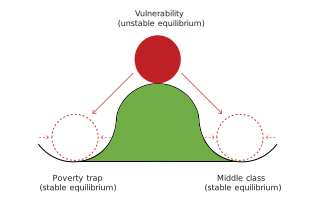
Figure 3 Vulnerability as an unstable equilibrium.
Although vulnerability is also considered an unstable equilibrium, moving to the middle class is not as easy as Figure 3 suggests. Larger changes, such as system-wide public education reforms, are needed for vulnerable individuals to develop risk mitigation mechanisms and resources that enable them to achieve economic and social stability, thereby advancing to the middle class. But they can easily be driven into poverty if they are negatively affected by shocks.
Figure 4 presents a more accurate depiction of vulnerability to poverty. The top of the mountain has a wide, upward-sloping peak instead of a sharp one: vulnerability is a zone, not a single point. The peak’s positive slope implies that a single adverse shock can quickly send a vulnerable person toward the ‘valley’ of poverty, while climbing to the edge of the vulnerability zone and moving into the middle class requires a significant and sustained uphill effort. This uphill effort emphasizes the need for long-term policy support to help households escape poverty, which we discuss further in Section 4.
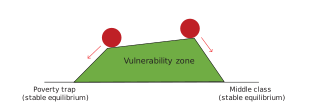
Figure 4 Inequality and vulnerability in a tipping point equilibrium.
- endowment
- A person’s endowments are the things they have that enable them to receive income. They include physical wealth (for example, land, housing, machinery); financial wealth (for example, savings, stocks/shares, bonds); intellectual property (for example, patents, copyrights); knowledge, skills, abilities, and experience that affect labour income; and citizenship and rights to work. They can include characteristics such as nationality, gender, race, and social class, if these affect their income.
A household’s location on this peak depends on their endowments: everything a person owns that allows them to receive and generate income, like financial assets, human capital, formal work, social capital, and geographic location. Endowments enable families to mitigate economic shocks and minimize their susceptibility to risk.
Think about someone who holds an undergraduate degree but is currently unemployed and has only a modest amount of savings. Despite their vulnerability, they are more likely to be positioned on the right side of the hill, closer to the stable equilibrium. Thus, if this person is exposed to favourable job market conditions, they could secure a well-paid job due to their professional background, and this individual could quickly move into the middle class and exit the vulnerability zone.
The concept of ‘multidimensional poverty’ acknowledges that poverty is more than monetary deprivation; it also includes the lack of other endowments such as human capital and access to basic infrastructure.
In contrast, a person without access to financial services and human capital would not have the resources to face a possible decrease in their income, and are more likely to fall into poverty. They would need a significant push to lead them to the middle class; simply having favourable labour conditions, as in the case of a person with an undergraduate degree, would not be enough to bring them into the middle class. For example, they would need access to education, financial services, and other types of support to climb up the positively sloped peak of the vulnerability zone. Therefore, they are more likely to be positioned on the left side of the hill.
Question 1 Choose the correct answer(s)
What role(s) do positive and negative shocks play in the context of tipping points and vulnerability?
- Negative shocks, for example, an economic recession, can affect all households.
- Shocks play a crucial role at tipping points, with positive shocks potentially enabling a household to rise out of vulnerability, and negative shocks increasing the risk of falling into poverty.
- Both types of shocks are important for households near a tipping point—a negative shock could cause a household to fall into poverty and a positive shock could move them nearer to the middle class.
- It depends on the size of the shock—if a household is close to the left edge of the vulnerability zone, a small positive shock will not be enough to push this household into the middle class.
-
Neidhöfer, Guido, Joaquín Serrano, and Leonardo Gasparini. 2018. ‘Educational Inequality and Intergenerational Mobility in Latin America: A New Database’. Journal of Development Economics 134: pp. 329–349. ↩
