
Vulnerability to poverty: Public, private, and community responses
5 The COVID-19 crisis: A challenge for public support policies after a shock
The global impacts of the COVID-19 pandemic on the economy have been profound, resulting in widespread job losses, business closures, and a surge in poverty. In Latin America and the Caribbean, the International Monetary Fund estimates that the region’s GDP contracted by 9.4% in 2020, the worst performance in 80 years. The pandemic also had a devastating impact on jobs and income in the region. Due to lockdown measures and the general paralysis of economic activities, hours worked in Latin America fell by 20.9%, and labour income declined by 19.3% during the first year. Millions of people lost their jobs or saw their wages slashed.
The pandemic’s impact was harshest on the most vulnerable countries, and within those countries, it hit the most vulnerable households and small businesses the hardest. As a response, governments worldwide initiated various strategies to assess and assist them. These measures encompassed:
- Cash transfers: Direct monetary allocations to individuals or households, typically dispensed monthly. Cash transfers addressed essential needs like sustenance and housing while invigorating economic activity through heightened consumption.
- Tax relief: Governments extended tax relief to individuals and businesses, alleviating their financial strain. By reducing financial burdens and incentivizing investments and spending, tax reliefs contributed to economic stimulus.
- Moratoriums on loan repayments: Governments could temporarily suspend loan repayment obligations for businesses and individuals. This mitigated financial stress and sustained the viability of businesses and households.
- Loan guarantees: Governments could provide loan assurances for businesses and individuals. This facilitated their access to credit and diminished default risk.
- Credit easing: Governments intervened by procuring government bonds or other assets from financial institutions, infusing additional liquidity into the financial system and consequently driving down interest rates.
- Investment in infrastructure: Governments channelled funds into infrastructural projects such as roads, bridges, and schools to foster job creation and catalyse economic growth.
Figure 14 shows the average value of government expenditure in the non-health sector during the pandemic’s first year, as a percentage of the country’s gross domestic product. This measure excludes direct spending on healthcare and captures the extent of spending on support programmes or other policies that mitigated the pandemic’s economic effects. Countries are shaded according to the size of this percentage, from light red (the lowest government expenditure) to dark red (the highest). The expenditures made by the wealthiest countries (as a percentage of GDP) are much higher than that of low-income countries, with upper-middle-income and lower-middle-income countries in between.
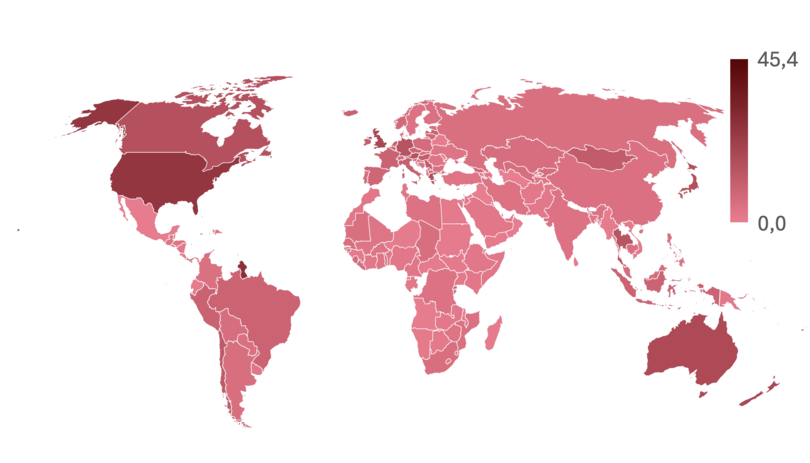
Figure 14 Government expenditure in the non-health sector as a response to COVID-19 as a percentage of GDP (2020–2021).
International Monetary Fund. 2021. Database of Fiscal Policy Responses to COVID-19.
Figure 15 shows that lower-income countries spent smaller shares of their GDP on social protection systems to support larger shares of vulnerable households. The main reason for this pattern is that low-income countries have a much smaller total GDP and smaller public spending budgets, despite having larger fractions of the population in need.
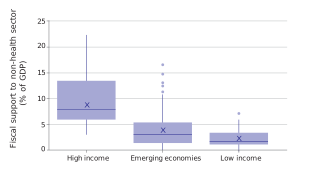
Figure 15 Box and whisker diagram of fiscal support to the non-health sector as a percentage of GDP (2020–2021). Note: The dots in the graph represent outliers or uncommon data, the x inside the boxes represents the data’s mean, and the lines inside the boxes represent the median of the data.
International Monetary Fund. 2021. Database of Fiscal Policy Responses to COVID-19.
Aside from variations in government expenditure, the mix of policies chosen differed across countries. Countries with well-developed social safety nets and a large formal sector focused on helping firms to retain their workers. For example, the United States allocated approximately 8.8% of its 2020 GDP for measures, such as the Paycheck Protection Program, to support businesses and workers and facilitate employment recovery. Another example is the European Union’s Pandemic Emergency Purchase Programme, which aimed to manage the risks that the pandemic posed to European financial markets.
In contrast, countries with less established safety nets and a large informal sector emphasized protecting families’ disposable income, mainly by providing cash transfers. A notable example is Colombia, which introduced a solidarity income policy to give financial transfers to vulnerable and impoverished households, taking advantage of a long-standing programme for cash transfers that facilitated the organization of resources and financial logistics. A distinct approach to addressing the COVID-19 crisis was the Indian government’s initiative to combat food insecurity, according to the Government of India and the United Nations.1 Since the 1960s, India has had a public distribution system (PDS) designed to distribute food grain at lower prices, and a rationing system that is operated between the central and state governments. Based on the infrastructure of the PDS, the government launched the Pradhan Mantri Garib Kalyan Yojana relief package to address the COVID crisis, which offered free food and easier mechanisms that would not require, among others, biometric verification. The programme reached more than half of the country’s population.
In middle-income countries, particularly lower-middle-income countries, governments had to intervene more decisively due to the large number of vulnerable households. The global impact of the COVID-19 pandemic disrupted community-based social protection systems, particularly remittances, which are financial transfers sent by migrants to their families in their home countries. In Latin America and the Caribbean, remittances play a crucial role as a primary source of income for millions of households, often utilized to meet basic needs such as food, healthcare, and education. They function as an informal social safety net for many vulnerable families. In response to the decrease in remittances, countries in this region had to take on more government debt to fund policies that formed a strong support system for these households. Depending on the fiscal policies of these countries, including tax reforms, public spending control, and dependence on international prices for export commodities like minerals or fossil fuels, they would make their macroeconomic stability more fragile, affect their credit ratings, and become more vulnerable to more expensive interest rates in future external loans. As the service to that debt increases, these countries will find it hard to manoeuvre on social spending.
The evidence on the effectiveness of microloans is mixed. Some analyses suggest that overall there is a small but positive effect, for example, see Chliova, Myrto, Jan Brinckmann, and Nina Rosenbusch. 2015. ‘Is Microcredit a Blessing for the Poor? A Meta-analysis Examining Development Outcomes and Contextual Considerations’. Journal of Business Venturing 30(3): pp. 467–487.
Other studies show that microloans help informal businesses: see Rezende, Beatriz. 2024. ‘Transforming Informal Economies: An Analysis of the Impact of Microloans in Rio De Janeiro’. Critical Debates in Humanities, Science and Global Justice 3(1).
But there are also studies that have shown null results: see Greyling, Talita, and Stephanié Rossouw. 2019. ‘Access to Micro- and Informal Loans: Evaluating the Impact on the Quality of Life of Poor Females in South Africa’. South African Journal of Economic and Management Sciences 22(1): pp. 1–14.
One similarity across countries was the focus on vulnerable groups, both in terms of health and income. From a healthcare perspective, many countries initially focused on implementing policies aimed at protecting those most susceptible to suffering medical complications. A clear example of this approach were decisions about distributing limited vaccine doses, where priority was given to those with pre-existing medical conditions or susceptible to greater risks, to significantly reduce deaths.
From an income perspective, beyond the policies described earlier, governments introduced an array of supplementary measures:
- Direct provision of essential goods: Governments proactively supplied households that were incapable of meeting fundamental needs with food, water, and other necessities.
- Support for the informal sector: Given the high levels of informal employment, particularly in low- and middle-income countries, governments extended aid through training initiatives and microloans.
- Investment in education and healthcare: Governments channelled resources into education and healthcare to enhance the long-term prospects of vulnerable households.
Not all countries were equally successful in preventing a rise in poverty and reviving their economies. The timing of policy implementation was vital in determining success. Governments that acted early had greater success in mitigating pandemic impacts than those that delayed policy implementation.2
The COVID-19 pandemic has made it clear that having strong social safety nets is crucial, and governments must prioritize preparing for economic crises in the future. While implemented policies have mitigated pandemic repercussions, an urgent and compelling need for more comprehensive safeguards against poverty remains.
Exercise 8 Comparing the COVID-19 pandemic response
Choose one high-income and one low-income country from the World Bank classification list, and research the public support policies that your chosen countries implemented in response to the COVID-19 pandemic. Describe some similarities and differences between the types of policies implemented.
-
United Nations World Food Programme and Government of India, Department of Food and Public Distribution. 2021. Food Security Response During COVID-19 and PDS Best Practices in Some States/Union Territories. ↩
-
Busso, Matias, Juanita Camacho, Julián Messina, and Guadalupe Montenegro. 2021. ‘Social Protection and Informality in Latin America During the COVID-19 Pandemic’. PloS One 16(11): e0259050. ↩
