
An overview of the publication process
CORE’s publications are created using a modern, digital-first book-production process, designed to produce multi-format content from a single, version-controlled source. These guidelines are most relevant to the first phase of that process—content development—but an overview of the full process is provided here to give you an idea of what to expect at each stage.
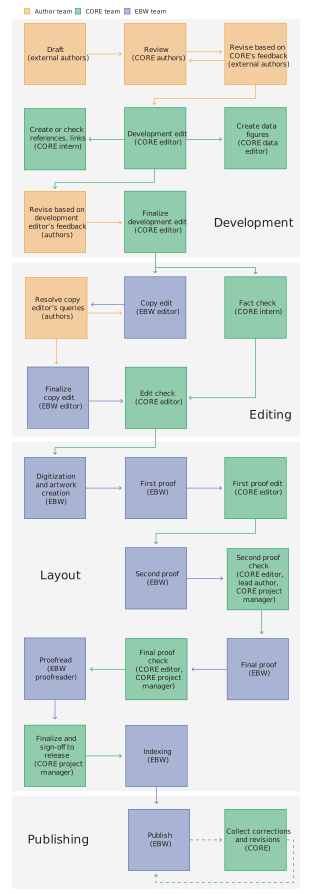
A visual overview of the production process for CORE publications.
The production process for CORE Insights is slightly different. Although many of the details are still relevant, teams creating Insights should refer primarily to the information within the CORE Insights authoring guidelines.
Phases and steps in the production process
Content development
-
Draft: A ‘best’ draft of the text is written by the authors, according to CORE’s brief and these guidelines.
The draft handed over to the academic editors for the review needs to be as complete as possible: creating chapters piecemeal, or handing work-in-progress, creates versioning problems, which lead to errors and delays.
Within their draft, the authors supply artwork briefs:
- for non-data figures, as mockups (ideally in PowerPoint, or alternatively within an Excel sheet or as an image file), and
- for data figures, as a dataset and a draft figure based on that dataset, within an Excel sheet.
At this stage, the data must be complete with references and any instructions for layout indicated, for use in later artwork creation steps.
-
Review: The CORE academic editors check the draft against the house style and an agreed ‘list’ of the basic elements:
- The house style deals with the detail of how the text is formatted and presented. It’s good to stick to this, because it saves time if the authors have already presented glossary definitions and figure headings (for example) in our consistent style. But it’s not essential, as formatting is checked during editing.
- More importantly at this stage, the academic editors need to ensure that the structure and editorial style is consistent across units, matches their brief, and also matches their larger vision of what the unit should achieve.
During this initial review process, it is likely that authors will need to make revisions to their content based on the academic editors’ feedback, and resubmit.
-
Development edit: A development editor reviews the document and edits it strongly for sense and clarity. Ideally, this person should not be a CORE author, as it is useful if they approach the text from the point of view of the reader, not the writer. They should also have some knowledge of economics, so they are not slowed down by making sense of the content.
Development editing involves:
- checking that all elements are complete
- identifying consistent elements such as boxes, tables, and sidenotes in the copy
- spotting gaps, or missing data, and requesting it from authors
- checking that titles, subtitles, and figures are titled accurately and numbered sequentially
- requesting rewrites if the text is not clear
- reorganizing sections or making deletions
- adding notes and comments to help the external editor, designer, and EBW production team.
The development editor may also create and provide a template for the authors to work into, as a Google Doc (example from Experiencing Economics).
This stage is designed to improve overall quality and clarity and to prevent delays later on due to missing content.
During the development edit, authors may be asked to respond to comments, check some suggested changes, and revise parts of the unit. These revisions will then be checked by the development editor (and further questions asked, if needed) before they complete their work on the unit.
-
Data and figures: A dedicated CORE data editor checks the artwork briefs supplied by the authors, and creates preliminary data figures using the CORE template dataset with particular attention paid to formatting the data, as indicated in the README document explaining the requirements for data storage.
These source data files will be published on CORE’s resources page when the publication is released.
-
References and links: All references and hyperlinks need to be identified and checked (see notes in the editorial house style), and the URLs shortened (see the notes on creating tinyco.re links).
This can happen at the same time as development editing, or after it; it is completed by an intern.
At the end of the development stage, the development editor should be able to send a complete text file, with all elements clearly identified, and all figures, LaTeX, links, and references in the correct format.
Editing
-
Copy edit: An external copy-editor (who will have some knowledge of economics, but whose primary skill is language) edits the text to improve readability and accuracy, and apply consistencies of style.
This step might generate queries which the authors (and development editor, when necessary) will resolve together with the copy-editor.
-
Fact check: While the copy-editor is working on the text (or after editing), a CORE intern creates a table of all external facts contained in the text, and finds a reliable source (not Wikipedia), and preferably a link, to back them up.
Any errors can be corrected at this point.
-
Edit check: The CORE editor reviews the edits, and makes changes based on the fact-check notes.
Create and correct proofs
-
Digitization: EBW adds the content to the relevant GitHub repository where it will be stored and managed.
They convert the text to markdown and add the code tags which apply the layout and functionality for all formats.
-
Artwork creation: Data figures are created by the data editor and quality-assured by EBW.
Non-data figures are created in Adobe Illustrator by EBW.
EBW optimizes the image files for use across multiple formats, and adds them to the relevant repository.
-
Review and correct first proof: A proof is provided as a preview site (that is, as the unpublished web format of the book).
The CORE editor checks the preview site and indicates changes in place using BugHerd (project-specific links to BugHerd will be provided by EBW, but for general guidance, see EBW’s notes on using BugHerd as a review tool, and the video demonstration of using BugHerd as a team member).
These changes are implemented by EBW.
-
Second proof: The EBW production team generates a second proof (updated preview site).
The second proof is reviewed in three rounds:
- By a CORE editor and EB member
- By the lead author(s)
- Again by the CORE editor and EB member, as well as by the CORE project manager for sign-off.
Changes are indicated in place using BugHerd, and are implemented by EBW.
-
Final proof: The EBW production team generates a final proof (updated preview site).
The CORE editor and project manager do a final review to make sure all the changes have been implemented, and the project manager signs off for proofreading.
-
Proofread: An external proofreader (managed by EBW) checks the content against the house style, for consistency, spelling, punctuation, and grammar.
This aims to catch any last errors prior to publication.
Proofreading changes undergo technical quality-assurance by EBW, and any queries raised by the proofreader are resolved by the CORE project manager (via the CORE editor or EB).
- Sign-off to release: The CORE project manager reviews an updated preview site again to ensure that the content is ready for public release.
- Indexing: A professional indexer (usually appointed by the print publisher) prepares a list of indexed terms, and EBW creates an index dynamically.
Publication
The live site is released. For most but not all books, PDF, app, and epub versions are generated by EBW.
PDFs go through a page-refinement process at EBW, where a person improves the automated layout page by page. If the book is to be published in print, any particular requirements from the publisher are also incorporated, and an early PDF sample is shared with the publisher for checking. This can take several weeks for big books.
- Screen PDFs are checked for glaring errors by the CORE team and usually made available for instructors to download.
- Print PDFs are checked by EBW, CORE, and the publisher before going to print.
- EPUB versions are uploaded to Apple iBooks and made available to download from CORE.
- App versions are uploaded to Google Play for Android and the Microsoft Store for Windows.
Maintenance
The publication is updated at regular intervals, following the errata process.
