
Authoring guidelines: CORE Insights
These guidelines outline and explain important details for authors of CORE Insights, including the production process, writing process, and features of CORE Insights.
Before you start
Familiarize yourself with:
- the CORE house style
- the CORE feature set (additional features specific to this publication are covered in the Insight features section of this page)
- the guidelines for writing and structuring new publications
- any other relevant content development guidelines
- the guidelines on preparing your content for production
- the existing Insights, such as ‘Too big to fail’ or ‘Government debt and sovereign wealth in the Global South’, for examples of the sections, features, and style to use.
The production process
CORE’s publications are created using a modern, digital-first book-production process, designed to produce multi-format content from a single, version-controlled source. These guidelines are most relevant to the first phase of that process—content development—but an overview of the full process is provided here to give you an idea of what to expect at each stage.
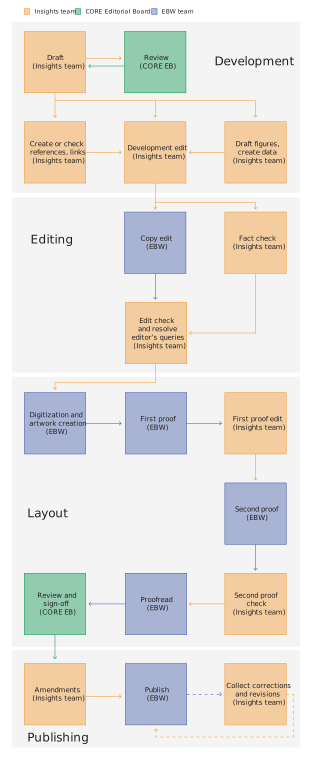
A visual overview of the production process for CORE Insights.
What is a CORE Insight?
A CORE Insight is a self-standing teaching and learning resource.
The aim of the Insights series is to make accessible cutting-edge research that sheds light on important problems we face. The target audience will vary by topic, but would be likely to include university students at different levels and other learners in policy institutions, NGOs, private sector organizations, as well as a broader public. The Insight will provide the economic context for the research by linking to the relevant conceptual treatment in CORE’s ebooks. In this way, the Insight will show how understanding the principles and concepts in the ebooks provides the basis for research and for university and professional courses at introductory level and beyond.
CORE Insights are author-signed and signed off by the CORE Editorial Board. Authors contribute their IP to CORE and the Insights are published under the Creative Commons BY-NC-ND license.
Writing a CORE Insight
Author template
We suggest that authors write the chapter using the ‘CORE Insight - Author Template’ document; this has the heading styles implemented already and also includes any text that is repeated in every Insight.
To use the template, click ‘File’ > ‘Make a copy’ and then work into your copy.
Please use the template alongside the instructions which follow.
Length
The length of an Insight should usually be between 10,000 and 20,000 words (including all questions, exercises and references). The Insight would normally comprise 1–2 weeks of study. Shorter Insights are also welcome.
Headings and information hierarchy
The title of the Insight should be formatted as a first-level heading (Heading 1).
Second-level headings (Heading 2) organize the content into its main sections.
Third-level headings (Heading 3) can be used to create subsections and fourth-level headings for sub-subsections (Heading 4). We would suggest using fourth-level headings sparingly, if at all.
Most of the headings are already included in the template, but if you need to add further headings please use Google Docs’ built-in formatting tools to apply the relevant heading level (for example, ‘Heading 3’), rather than styling headings by applying a font size, bold, italics or underline.
Sections
Each Insight should include these sections:
Chapter heading (CORE Insights/CORE Insights from the Global South: Insight name)
Highlights
1 Introduction
2 Main section heading (the exact number of main sections will vary)
3 Main section heading
4 Main section heading
5 Main section heading
6 Where next for [Insight topic]? (section to be included when applicable)
7 Conclusion
8 References
Detail about each of the sections follows.
Highlights
Each insight starts with a set of bullets conveying the main learning outcomes. This section is not numbered.
Aim for around 5–6 bullet points covering the main points made in the Insight. These should be worded as a brief summary (an example from Unit 10 of The Economy is: ‘Banks are profit-maximizing firms that create money in the form of bank deposits in the process of supplying credit.’). Ideally these bullet points will roughly map onto the structure of the Insight, for example, one bullet point per section, however this is flexible and the most important thing is to ensure they provide an overview of the material included.
At the start, please include the author detail and links to related CORE material (see the prerequisites box section of this page for details on how to write and mark up this feature).
1 Introduction
Following the highlights section with its bullet-point overview is an introduction with a ‘CORE-style hook’ (see this example from the ‘Too big to fail’ Insight), which is a real-life story that interests readers and illustrates the big themes of the Insight. Note that in other CORE ebooks, the bulleted highlights and introductory hook may be one introduction section, while in CORE Insights, the Highlights and Introduction are separate sections.
The introduction should provide an overview of the issues covered in the Insight. If applicable for the topic, it might start with a statement of the problem, along with the context and timeline. This will give the reader enough context for what follows.
The introduction should end with a brief description of the content and structure of the Insight, so that the reader gets an idea of what to expect (example from The Economy 1.0: ‘In this unit, we study how, in the modern capitalist economy, the coordination of labour takes place within firms. We model how wages are determined when there are conflicts of interest between employers and employees, and look at what this means for the sharing of the mutual gains that arise from cooperation in a firm.’).
While writing the introduction, keep in mind CORE’s aims of addressing the sorts of questions that motivate students (and other learners) to take up economics, helping students (and other learners) to understand economic challenges in the real world, and preparing students (and other learners) to confront such challenges.
2–? Main sections
The main part of the Insight should be divided into a suitable number of sections. The ideal section length is around 1,500–2,000 words (excluding questions, exercises, figures, and so forth). The following advice relates to each of the main sections in the Insight:
-
Avoid long chunks of text. Use bullet points, numbered lists, and/or tables and figures to break up the text, facilitate understanding, and add interest. Consider using subheadings within the sections to break up the text and guide the reader through the Insight.
-
Ensure the journey through the text is clear to the reader. The overview in the introduction will be most important. Also consider adding comments such as ‘as we discussed earlier’, ‘we will come back to X in Section Y’, and ‘there are two main advantages; we’ll discuss the first one here and the second one in Section Z’. It can also be useful to include a mini introduction (even as short as a sentence, for example, ‘Let’s look at how the evidence-based policy cycle works in practice.’) at the start of each section, to very briefly set out what will be covered in the section.
-
Content is written to be accessible to first-year undergraduates. Any technical or supplementary material that first-year undergraduates might find challenging, or that is not crucial to understanding the main text should be in ‘Find out more’ boxes. See this example in Economy, Society, and Public Policy.
Features
Please include the following in your main sections (see the Insight features section later for details of how to write and mark up these features):
- Cross-references: Please include cross-references to CORE’s ebooks to help readers fill in their knowledge gaps. To the best of your knowledge, all relevant sections in CORE’s ebooks should be signposted in the text, using wording such as ‘to find out more about XYZ, see Section Z in The Economy’. A member of the CORE team can help with this.
- Footnotes: Please note that footnotes should only be used for references.
- Multiple-choice questions (MCQs): Each main section should include at least one ‘Question’ (in the form of an MCQ), with answers and feedback, usually at the end of the section, but it can be earlier if you prefer.
- Exercises: Please also aim to include an exercise in most of the main sections. These aim to encourage the student or learner to consider how to apply what they are learning to different contexts and to test their ability to use relevant analytical tools themselves.
- Boxes: Please consider using boxes, where appropriate. See the Insight features section for a list of the different boxed features that can be used.
6 Where next for [Insight topic]?
Please adjust the heading numbers for this and the following two sections, if necessary.
This section is optional and can be included if applicable for the topic.
7 Conclusion
The conclusion should be structured as follows:
- Draw together the discussion in a few paragraphs.
- Summarize what has been covered, in a few bullet points (each point can be a few sentences long).
- Finish with future directions in a paragraph or two.
8 References
See the house style for guidance on referencing styles. (Example from the ‘Government debt and wealth in the Global South’ Insight.)
Insight features
A chapter feature is any element which is repeated in the book. In other words, features are a group of elements that have distinct purposes, and are consequently given a distinctive design.
The features used in this publication are explained in detail within the CORE feature set, and those specific to CORE Insights are explained within this section.
Those specific to Insights include the following boxes (also see details in the CORE feature set):
Other CORE features used in this publication and explained in the feature set section are:
- Header image
- ‘Find out more’ boxes
- Multiple choice questions (MCQs)
- Exercises
- Sidenotes
- Links
- Defined key terms
- Figures
- Multi-image figures (slidelines)
- Videos
- Footnote references
- Bibliographic references
‘Prerequisites’ box
Note: This feature is currently called a ‘Prerequisites box’ because it reuses the design of the ‘Before you start’ boxes in The Economy 2.0. Its name may be updated in future.
This box appears at the start of the Insights’ highlights section. (Example from the ‘Government debt and wealth in the Global South’ Insight.)
Within the box, the author(s), their institution(s), and the publication date are listed beneath the heading ‘Author(s)’.
Links to related material and recommended reading in other CORE projects, The Economy 1.0 and 2.0, Economy, Society, and Public Policy, and Doing Economics, are also listed within the box, under the heading ‘Concepts’.
Place the content between these tags and use the following wording. There is no need to use any additional formatting, such as placing it within a box.
[Prerequisites box]
Author(s)
Authored by [name] [(institution)].
Concepts
Concepts in this Insight are related to material in:
- [add as a hyperlinked list]
Recommended reading before starting this Insight:
- [add as a hyperlinked list]
[end box]
Full-width ‘info’ boxes
These can be used when you want to provide additional information in a box (example).
Mark up the text with [Full width info box] and [End full width info box].
Before handing over authored content
Ensure that you have followed the guidelines and have run through the pre-digitization checklist given in the Preparing your content for production section of this documentation.
